
A naming workshop is a structured working session, usually two to four hours, where a small group agrees what a name must do, generates a large pool of options, cuts them against clear criteria and leaves with a short list that is ready to be tested and checked. It is not a brainstorm with sticky notes and a vote at the end. The brief before it and the checks after it decide whether the name survives. This guide covers the lot, with an Australian lens on business names, domains and trade marks, and a section most guides skip: testing names with the people they are meant to reach, including people with disability.
TL;DR
- A naming workshop produces a shortlist of three to five names, scored against agreed criteria. It does not produce a single winner on the day.
- Write the brief first: who the name is for, what it must signal, what it must never do. Without that, the room argues about taste.
- Check every shortlisted name on the ASIC register, IP Australia’s TM Checker and auDA’s domain search before anyone falls in love with it.
- Test the shortlist with the people you serve, with access needs planned in from the start, not added at the end.
- A name is not a brand. Once chosen, it needs messaging, a voice and a visual identity to carry it.
Table of Contents
- What a naming workshop is, and what it should produce
- Naming workshop or brand sprint?
- Before the day: write the brief
- Running the session: a three-hour agenda
- After the workshop: check availability in Australia
- Test the shortlist with the people it is for
- Our perspective
- From name to brand
- FAQ
- Sources
What a naming workshop is, and what it should produce
The job of a naming workshop is to compress weeks of circular email threads into one focused session. Everyone who has a stake sits down with the same brief, the same criteria and the same time limit.
A good one produces four things:
- A written naming brief, agreed before or at the start of the session.
- A long list, often 40 to 100 raw ideas, grouped by approach.
- A scored shortlist of three to five names.
- A checking and testing plan, with owners and dates, for what happens next.
If you leave with only a favourite name and a feeling, the workshop did half its job. The name will be challenged later by a trade mark clash, a CEO’s cousin or a community member who reads it differently from the way you intended. The scoring and the paper trail are what let you defend the choice.
Naming workshop or brand sprint?
The two terms get mixed up. A brand sprint is a broader alignment exercise. Teams work through what the organisation stands for, who it serves, how it wants to sound and where it sits among alternatives. A naming workshop is narrower: one question, what should we call this?
Use a naming workshop when the positioning is already clear and the name is the missing piece: a new program, a product, a merged organisation, a social enterprise about to launch. Use a brand sprint when you cannot yet say what you stand for. Naming before positioning is the most common reason a name feels flat. If you are not sure which side you are on, run a short alignment session first and fold the naming session in straight after. Our guide to a brand messaging framework is a good way to get the positioning written down before you start.
Before the day: write the brief
Spend an hour on the brief for every hour in the room. A working naming brief answers these questions in plain language:
- What are we naming? An organisation, a program, a product, an event. Each has different legal and practical needs.
- Who is it for? Be specific. “People with disability” is not an audience. “Parents of children newly diagnosed with a hearing loss” is.
- What should the name signal? Two or three qualities, such as warmth, expertise or independence.
- What must it avoid? Medical jargon, deficit language, puns that land badly, anything that sounds like an existing organisation.
- Where will it live? A shopfront, a website address, social handles, a spoken phone greeting, a screen reader.
- What are the hard constraints? Length, language, domain availability, trade mark classes you will need.
The last two matter more than they appear. The Australian Government’s business guidance recommends names that are easy to pronounce and spell, short and simple, meaningful to customers and distinct from similar businesses. Turn those into scoring criteria. They cost nothing and they settle arguments.
Choose the people in the room
Keep the group small. One practical benchmark: GitLab’s handbook suggests a 50-minute live brainstorm with six to eight stakeholders to build a shortlist and vote on the top choices. That is a lean format for a product name. For an organisation’s name, give yourself two to three hours and add the voices that matter.
Aim for a mix. Naming specialists suggest bringing together people from different parts of the organisation, because a leadership-only room produces names that sound like leadership. For a disability organisation, that mix should include people with lived experience of disability, not as a token guest but as participants with equal say. Add one person whose job is to hold the criteria and call time. That person is not the loudest voice in the room.
Plan access before you send the invitation
An inclusive workshop is designed, not adjusted on the day. Ask each participant directly what they need. The Australian Human Rights Commission’s guidance on accessible communications advises asking people about their communication needs and requirements rather than guessing.
The Victorian Government’s better practice guide for inclusive engagement lists the kinds of things to plan for: accessible venues with ramps and quiet spaces, Auslan interpreters, captioning, plain language and Easy Read versions. In practice that means:
- Send the brief and agenda a week ahead, in plain language, in an accessible format.
- Book interpreters and captioning early, and brief them on the names and jargon you will use.
- Build in breaks. Naming is tiring, and a long unbroken session favours the fastest talkers.
- Offer more than one way to contribute: spoken, written, drawn, or submitted before the session.
- If you run it online, check that the platform works with screen readers and captions. Our WCAG 2.2 checklist is useful for the digital side.
The same guide recommends strength-based, person-first language and asking participants how they prefer to be referred to. Some people prefer identity-first language. Ask, record the answer and use it in every document that follows.
Running the session: a three-hour agenda
The structure below suits a team of six to ten. Shorten each block proportionally for a tighter format.
| Time | Block | What happens |
|---|---|---|
| 0:00 to 0:15 | Alignment | Read the brief aloud, confirm the scoring criteria, agree house rules |
| 0:15 to 0:35 | Baggage dump | Everyone writes down names they already like, dislike or have been told to use |
| 0:35 to 1:25 | Generate | Timed rounds across several naming approaches |
| 1:25 to 1:40 | Break | Genuine break, away from the wall of ideas |
| 1:40 to 2:20 | Cut and score | Remove clear misses, score the survivors against the criteria |
| 2:20 to 2:50 | Stress-test | Say each name aloud, read it in a sentence, imagine it on a phone greeting |
| 2:50 to 3:00 | Next steps | Confirm the shortlist, checks, testing plan and owners |
Start with the baggage
The braindump of naming baggage is the step teams are most tempted to skip and the one that saves the most time. Everyone has a pet name from three years ago. Get them onto the table in the first twenty minutes, treat them as options like any other, and the rest of the session is far calmer.
Generate with different approaches
Don’t ask for “ideas”. Ask for names in specific families, one round each, ten minutes per round:
- Descriptive: says what you do. Clear, but hard to own and often hard to trade mark.
- Evocative: suggests a feeling or image. Memorable, needs explaining once.
- Invented or blended: made-up words or combined fragments. Distinctive, easier to protect, harder to spell.
- Metaphor or place: borrowed from nature, landmarks, language or story. Check the cultural sources carefully and get the right permissions, especially with First Nations words.
- Free association and word play: the same marketing workshop guide mentions free association, Scrabble tiles and role-playing. Physical letters on a table get quiet people involved quickly.
Run the first five minutes of each round in silence, individually. Then share. This stops the first confident suggestion from anchoring everyone else.
Cut, then score
Cut in two passes. First pass: remove anything that fails a hard constraint (clashes with a known organisation, is difficult to pronounce, carries an unwanted meaning). Second pass: score the rest from one to five against your criteria. A simple set that works for most Australian organisations:
| Criterion | What you’re asking |
|---|---|
| Clarity | Can someone spell it after hearing it once? |
| Meaning | Does it suggest what we stand for? |
| Distinctiveness | Does it stand apart from similar organisations? |
| Respect | Is it free of deficit or patronising associations? |
| Accessibility | Does it read well with a screen reader and in Easy Read? |
| Availability | Is it likely to be free as a domain, handle and trade mark? |
Add weights if one criterion matters more. Keep the top three to five names.
The say-it-out-loud test
Before the session ends, put each shortlisted name through ordinary use. Say it on a pretend phone call. Write it in an email signature. Read it as a screen reader would. Names built from unusual spellings or stylised capitals often sound fine in a meeting and fall apart in speech, or read as a string of letters on assistive technology.
After the workshop: check availability in Australia
A name that people love and cannot use is worse than a plain name. Run the checks on the shortlist, not only on the winner, so a failure does not send you back to the beginning.
The government’s guidance on choosing a business name sets out the sequence: search the ASIC business register, use IP Australia’s free TM Checker for similar trade marks, and check domain availability through auDA’s search. It also suggests checking whether matching social media handles are available.
The distinction between these registrations catches many people out. A business name, company name or domain name is not a trade mark. A registered trade mark can give exclusive rights in Australia for the goods or services it is registered for. It is protected for 10 years from the filing date and can be renewed every 10 years. So registering a business name with ASIC does not stop another organisation from holding a trade mark in a similar name.
A practical checking order:
- Trade marks first. It is the most expensive problem to fix later.
- ASIC business names register. Look for identical and near-identical names.
- Domain. Look at the exact match and the sensible alternatives.
- Social handles. Check the platforms your audience actually uses.
- Plain search. Search the name with your sector terms. If another organisation dominates the results, you will fight for visibility.
If the name is central to a fundraising or commercial plan, take the shortlist to a trade mark attorney before you commit to printing or launch. A screening search on a government tool is a good start, not legal advice.
Test the shortlist with the people it is for
A name can score well in the room and still misfire in the community. People inside an organisation know what it does. People outside hear only the word.
Testing does not need to be a big research project. For a shortlist of three to five names, a round of short conversations is often enough. The questions are simple:
- What do you think this organisation does, based only on the name?
- What feeling does it give you?
- Does anything about it make you uncomfortable or sound out of date?
- Which of these would you be most comfortable telling a friend about?
Digital NSW’s usability guidance recommends inclusive research from the beginning with diverse users, including different abilities, ages, languages and locations, and its inclusion perspective is that learning directly from people is more accurate than assuming their needs and experiences. That applies directly to names: you cannot predict how a word will land with someone whose life it describes.
Make the testing itself accessible
- Recruit through trusted networks: disability organisations, peer groups and community leaders, not a generic panel.
- Offer choice in format: one-on-one, small group, written feedback or a recorded response. Neurodivergent participants, Deaf participants and people with speech or cognitive disability will each prefer different setups.
- Present names in more than one way. A 2024 Victorian design awards entry for a brand project describes presenting visual designs verbally to accessibility consultants and stress-testing the experience with screen readers. For names, read each aloud and show it written, so people who do not use sight or sound alone can respond equally.
- Pay people for their time and expertise. Lived experience is expertise.
- Report back. Tell participants which name was chosen and what their feedback changed.
If feedback conflicts, go back to the brief. The audience’s reaction outranks internal preference, but the brief tells you which reactions matter most.
Our perspective
We have sat in a lot of rooms where a disability organisation is choosing a name, and the same pattern repeats. The shortlist is full of safe words: “Connect”, “Together”, “Empower”, “Unlimited”. They are fine words and they belong to hundreds of other organisations. The generic imagery and messaging that disability brands have been stuck with start right there, with the name.
Our team includes young creatives with disability, and that changes what we notice. We hear when a name sounds like a charity talking about people instead of to them. We catch names that are hard to use with a screen reader or in captions. And we push for names with some personality, because a distinctive name is easier to remember, easier to protect and easier to build a visual identity around.
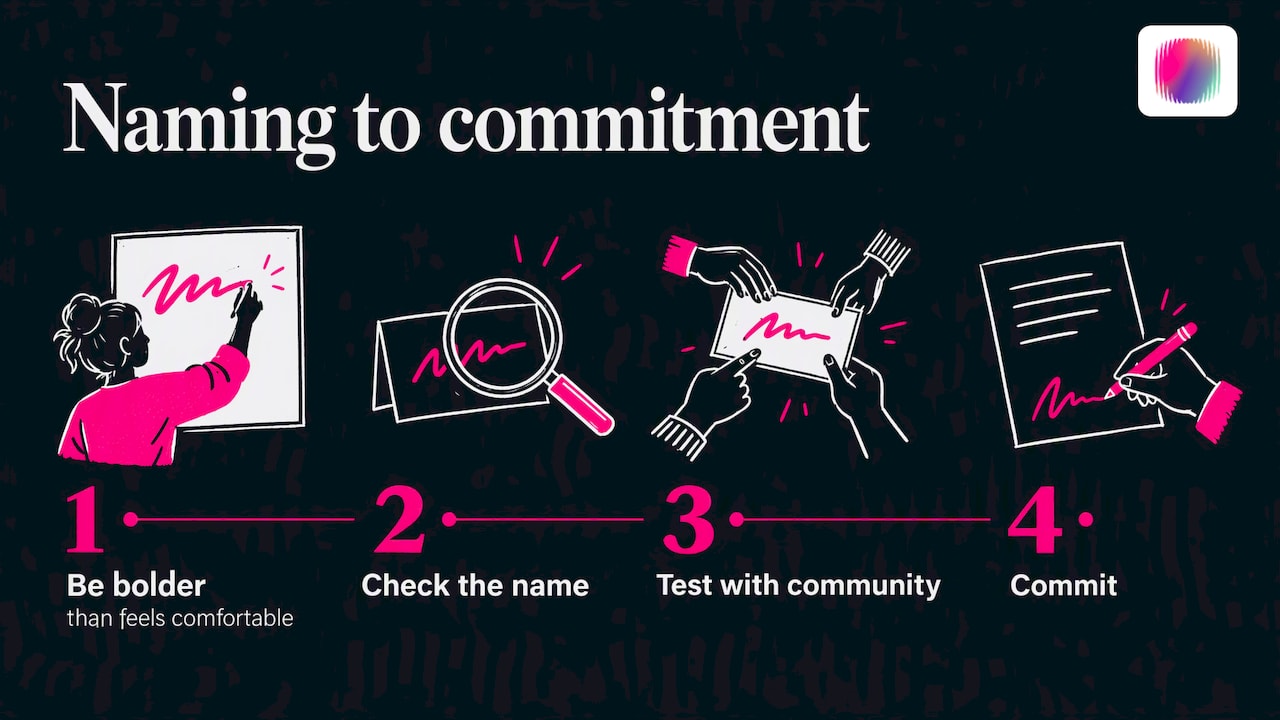
Our advice is to be bolder than feels comfortable in the workshop, then be rigorous afterwards: check it, test it with the community, and only then commit. A good name should survive both the room and the real world.
— Tommy
From name to brand
Choosing the name is one step of several. Once it is signed off, it needs a voice, messaging and a visual identity that make it feel like something. Our brand voice guidelines guide shows how to write down how the name should sound in practice, and our nonprofit rebranding guide covers what a change of name means for existing supporters, signage and websites.
If you would rather not run the process alone, DISBRANDED works with disability organisations, social enterprises, startups and established businesses on brand strategy, visual identity, web design, content and social media. Our team has lived disability experience, and we bring that into naming, positioning and testing from the first conversation.
See what we offer on our services page, or get in touch through the DISBRANDED home page to talk about your naming project.
FAQ
How long should a naming workshop run?
Two to three hours suits most organisation or program names, with a break in the middle. A product name with a tight brief can be done in under an hour, as GitLab’s handbook suggests. Anything longer than half a day tends to produce fatigue rather than better names.
How many people should be in the room?
Six to ten is a workable range. Fewer than six lacks variety of views, and more than ten makes it hard for everyone to contribute. Ask for wider input through a pre-session survey or a testing round rather than adding more chairs.
Do we need an agency to run a naming workshop?
No. A prepared internal facilitator can run the session using the agenda above. An outside facilitator helps when the group has strong internal politics, when nobody has time to prepare the brief, or when you want an experienced view of how the names will land with a specific audience.
Is registering a business name enough to protect my name?
No. A business name, company name or domain name is not a trade mark. Registration with ASIC records the name for trading, while a registered trade mark gives exclusive rights for the registered goods or services. Search the trade mark register using IP Australia’s TM Checker before you commit.
How do I test names with people with disability?
Ask participants about their access needs first, offer several ways to respond, present each name both written and spoken, and pay people for their time. Keep the questions simple: what does the name suggest, how does it feel, and does anything about it seem off? Work with a disability organisation or peer network to recruit, rather than a general panel.
Sources
- Choose a business name | business.gov.au
- Trade mark | business.gov.au
- The naming process at GitLab | The GitLab Handbook
- 10 Steps to a Successful Naming Workshop | MarketingProfs
- Creating accessible and inclusive communications | Australian Human Rights Commission
- Better practice guide for inclusive engagement | Victorian Government
- Usability testing | Digital NSW
- Spoony: All of the Friends. None of the Fear. | Victorian Premier’s Design Awards