
A nonprofit rebrand is a deliberate change to how supporters, clients, funders and staff perceive and experience your organisation. It is not a new logo on old habits. Done well, it starts with strategy, involves your board and the people you serve, and ends with months of consistent use after launch. For Australian charities it also carries legal housekeeping, and for disability organisations it carries an accessibility standard that should shape every decision from the first workshop.
This guide walks through the process in the order it actually happens, with a checklist, the Australian regulatory steps and the traps we see most often.
TL;DR
- Rebranding is a strategic decision about purpose, audience and positioning first, and a design job second. A new logo alone is a refresh, not a rebrand.
- Get the board involved early, name one internal lead, and choose a partner who understands your organisation, not just design.
- If your legal name changes, tell the ACNC: within 28 days for medium or large charities and 60 days for small ones.
- For disability organisations, involve people with disability in discovery, testing and governance, and build accessibility into the brand system from day one.
- Plan for adoption. Launch day is the middle of the project, not the end.
Table of Contents
- What nonprofit rebranding actually covers
- Is it the right time to rebrand?
- The nonprofit rebranding process, step by step
- Australian specifics: ACNC, names and records
- A rebrand checklist you can adapt
- Why nonprofit rebrands go wrong
- Social media and the day-to-day brand
- Our perspective: brands in the disability sector
- Working with us on your rebrand
- FAQ
- Sources
What nonprofit rebranding actually covers
The word gets used loosely, so it helps to separate three levels of work. One practical distinction is that a full rebrand changes internal strategy and external identity, a brand refresh changes mainly the visual identity, and a brand update produces new supporting materials within the existing identity.
The same source describes rebranding as changing how an organisation is perceived and experienced. That can include purpose, positioning, audiences, messaging, personality, name, visual identity, website and the systems that help people deliver the brand consistently.
It also does not have to be all-or-nothing. As Lauren Bauer of Corus International says in NonProfit PRO, a rebrand may involve a new name, logo, personality or organisational restructure, or only some of those. For an organisation with decades of trusted history, that matters: you can sharpen your identity without discarding the goodwill you have earned.
Here is how the three levels compare in practice.
| Level | What changes | Typical trigger |
|---|---|---|
| Brand update | New brochures, templates, social content, within the current identity | The brand is sound but materials look tired or inconsistent |
| Brand refresh | Logo, colours, typography, imagery | The identity looks dated or fails accessibility checks, but the strategy still holds |
| Full rebrand | Purpose, positioning, messaging, name and visual identity | Your mission has grown, merged or shifted, or your brand no longer says what you do |
Is it the right time to rebrand?
Before you brief anyone, test the reasons. Good reasons are specific and about the mission. Weak reasons are about taste or a new executive’s preferences.
Reasons that usually justify the work:
- Your programs or audience have expanded and the current name or story no longer fits. A 2026 CASE Journal case study frames rebranding as a decision about alignment, stakeholder management, timing and impact measurement, not only aesthetics.
- You have merged with another organisation, or you are consolidating several programs under one identity.
- People confuse you with similar organisations, and your funding or referrals suffer for it.
- Your communications are inaccessible or contradict your values, for example imagery that presents the people you serve as objects of pity.
- Supporters or clients tell you the brand does not represent them.
Reasons to pause:
- The real problem is a weak fundraising offer, poor service delivery or an out-of-date website. A rebrand will not fix those, though it can expose them.
- You have no capacity to carry the change through after launch.
- The board is split and nobody owns the decision.
There is also a genuine tension to manage. Hospice research describes concerns that branding can look too commercial, while donor research in the same area found that transparency, personal tone and impact-specific communication build trust. The answer is to treat the rebrand as a way to clarify your impact and accountability, and to be able to explain the spend in those terms to your members and donors.
The nonprofit rebranding process, step by step
Every organisation’s path differs, but the sequence below holds up whether you are a small advocacy group or a national service provider.
1. Build the case and secure the board
Write a one-page case: what is not working, what you expect to change, how you will know. Commentators in the Forbes Nonprofit Council point to three conditions that drive success: meaningful board involvement for an external perspective, a flexible branding partner who takes time to understand the organisation, and a capable internal marketing or communications lead to carry the work forward.
Ask your board for a clear decision on scope, budget range and who has final sign-off. Rebrands stall when approval is vague.
2. Run discovery with the people you serve
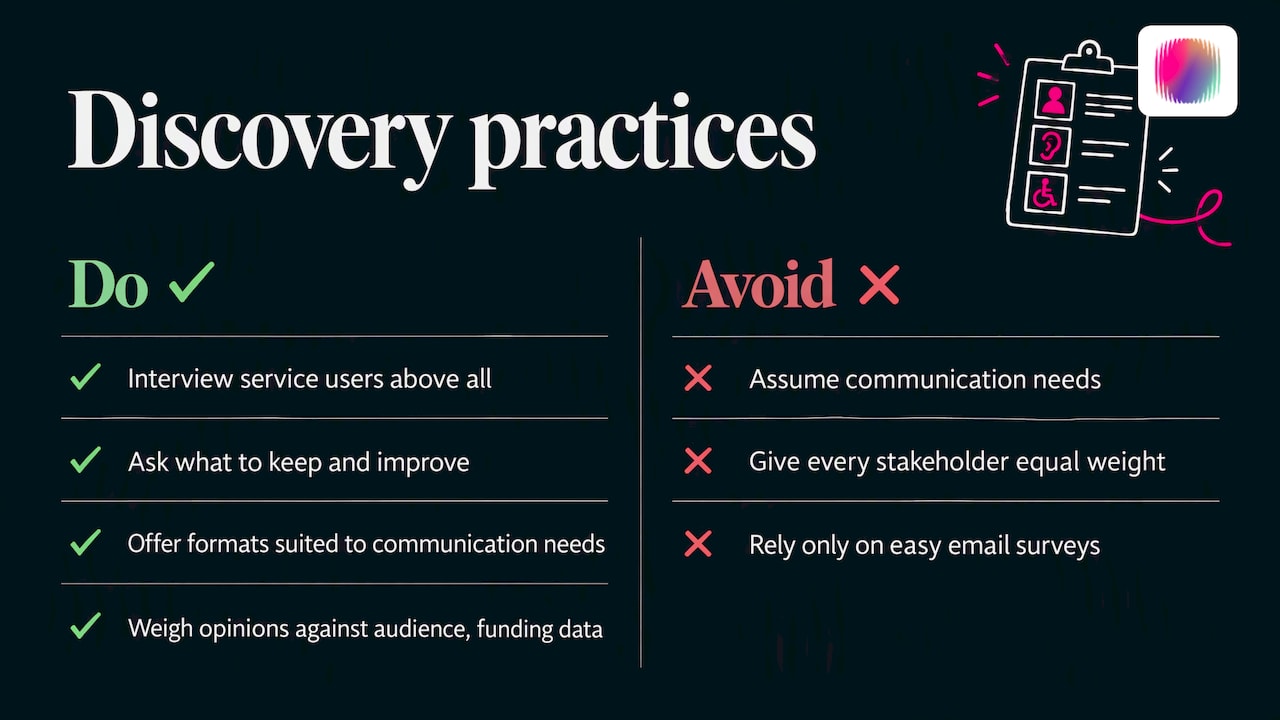
Discovery is where most of the value is. Interview staff, board members, volunteers, donors, partners and, above all, the people who use your services. Ask what they think you stand for, what they would never want you to lose and where you disappoint them.
For disability organisations, this step is also your first accessibility test. The Australian Human Rights Commission advises organisations to ask people about their communication needs rather than assume them. Offer interview formats that suit different people: written responses, phone, video with captions, Easy Read surveys, in-person with an interpreter or support person. If discovery is only accessible to people who find email surveys easy, you have already skewed the findings.
Be wary of listening to everyone equally. Practitioners cited by Forbes and NonProfit PRO stress that change management means listening to stakeholders while staying guided by evidence. Collect opinions, then weigh them against data on your audiences, funding and reach.
3. Settle strategy before design
Strategy answers a handful of questions in plain words:
- Why do we exist, and for whom?
- What makes us different from other organisations in our space?
- Who must we persuade or serve, and what do they need to hear?
- What personality should we have in how we write and speak?
- What do we promise, and can we keep it?
The output is a short brand strategy document: purpose, positioning, audience, voice and key messages. Every later design decision gets tested against it. If your team cannot summarise the strategy in a sentence, it is not finished.
4. Decide on the name
Naming is the highest-risk decision. A new name affects your legal records, domain, email addresses, signage, grant agreements, search visibility and the memory of everyone who knows you.
A trend worth considering carefully is moving from a descriptive name to a broad, general one. A descriptive name tells people what you do. A broad name is flexible but means nothing until you have built the meaning. If your funding depends on people instantly understanding your cause, keep that in mind. Often the better route is to keep a recognisable name and change the identity around it, or to add a clear descriptor line.
5. Develop the visual and verbal identity
Only now do logos, colour palettes, typography, photography style, tone of voice and templates enter the picture. Insist that the system is built for accessibility from the start:
- Colour combinations that meet contrast requirements in both light and dark settings.
- Typography that remains legible at small sizes and for people with dyslexia or low vision.
- Image guidelines that show people with disability as leaders, professionals and decision-makers, not as props.
- A voice guide with plain language rules and an Easy Read version of key messages.
- Social templates that work with screen readers, including alt text standards and captioning.
The Commission’s guidance covers screen readers, voice input, Easy Read, accessible meetings and accessible digital materials. Use it as a brief for your designers, not a final audit.
6. Test with real users before you commit
The CASE Journal case study suggests a practical implication: test whether the new identity supports the organisation’s expanded mission before committing to a public launch. Show two or three directions, or the final candidate, to a mixed group of staff, clients and supporters. Include people who use assistive technology to test the website and documents. Ask what the brand says about you, not whether they like it.
7. Sort out the legal and operational details
This is the step many guides skip. See the next section.
8. Launch in stages, then keep going
Start with an internal launch so staff, board and volunteers can explain the change before the public hears it. Then move to key partners and funders, and then to the public. Our rebrand rollout plan and checklist covers the first 90 days, where most inconsistencies creep in: the old logo in an email signature, a stale PDF on the website, a partner page still carrying the former name.
Australian specifics: ACNC, names and records
A name change is operational, not just visual. The ACNC says registered charities have a duty to notify it of changes to their legal name, address for service, responsible people and governing document. Notification is due as soon as reasonably possible and no later than 28 days for medium or large charities, or 60 days for small charities. There is no fee, but administrative penalties may apply if you fail to notify. The page also notes you may need to tell other Commonwealth, state and territory regulators. If the legal name changes, your governing document will usually need updating too, and the ACNC form asks you to upload the new copy.
The reason this matters goes beyond compliance. ACNC transparency and public trust depend on accurate information on the Charity Register about a charity’s governance, activities and finances. A mismatch between your public identity and the register looks careless to a donor or funder doing due diligence.
If you are changing legal structure or ABN, for instance as part of a merger, the ACNC has separate guidance on changing your charity’s ABN or legal structure, including reviewing whether your purposes still entitle you to registration. Speak to your lawyer or accountant before you announce anything, and check any state or territory fundraising and incorporation requirements that apply to you.
Map these items before launch day:
- Proposed name against your legal entity name and any registered business names.
- ACNC Charity Register details and governing document.
- ABN records, bank accounts, insurance policies and grant agreements.
- Domain names, email addresses and social handles.
- Donation pages, payment gateways and receipts.
A rebrand checklist you can adapt
Use this as a working list and assign an owner and a date to each line.
| Stage | Check |
|---|---|
| Decide | Written case for change, board approval, budget range, named internal lead |
| Discover | Accessible interviews and surveys, audience data reviewed, findings summarised |
| Define | Purpose, positioning, audience, voice and key messages signed off |
| Name | Options tested, legal and domain checks done, ACNC notification planned |
| Design | Logo, palette, type, imagery and templates built to accessible standards |
| Test | Review with clients, staff and assistive technology users, changes made |
| Prepare | Brand guidelines, template library, website build, signage and merchandise list |
| Launch | Internal first, then partners and funders, then public |
| Embed | Training, asset library, old-material audit, review at 90 days |
For the full sequence of weeks and what depends on what, see our guide to how long a rebrand takes in Australia.
Why nonprofit rebrands go wrong
Most failures trace back to a short list of causes.
Skipping strategy. A logo is chosen because the committee likes it, and nobody can say what it is meant to achieve.
Treating the board as an approver, not a partner. Late objections force expensive rework.
No internal owner. The agency finishes and nobody maintains the brand.
Ignoring adoption. The hidden workload is getting staff, board members, fundraisers, partners and volunteers to understand and use the change consistently. Supporter communication also continues after launch rather than ending on the day.
Accessibility as an afterthought. A beautiful identity that fails screen readers or colour contrast excludes the very people a disability organisation exists to serve.
Looking like a spending spree. Without a clear explanation of the reason and the benefit, donors may see the change as cosmetic. Say what is changing, why, and what it means for your impact.
Social media and the day-to-day brand
For most Australian nonprofits, social channels are where the new brand is seen most often, and where inconsistency shows first. Update profile images, banners, bios, link-in-bio pages and pinned posts on launch day, and brief whoever runs your accounts on the new voice. If Instagram is a priority channel, our practical Instagram guide for Australian nonprofits covers how to put a brand to work there.
Our perspective: brands in the disability sector
We have spent over 20 years in branding, and our view is shaped by one pattern: the disability sector is full of organisations doing excellent work behind identities that look and sound the same. The stock photo of a person in a wheelchair gazing at a sunset, the soft blue palette, the language of inspiration and need. Supporters scroll past it, and the people you serve feel unseen by it.
A rebrand is your chance to stop being generic. That means three things in practice.
First, strategy must come from lived experience, not from assumptions about it. Our team includes young creatives with disabilities, and that perspective changes the questions we ask in discovery, the imagery we propose and the way we test accessibility. It is not an add-on at the end.
Second, distinctiveness comes from truth. The most memorable disability brands we have seen are specific about who they are, what they believe and what they refuse to do. Bold design on top of a vague strategy still reads as vague.
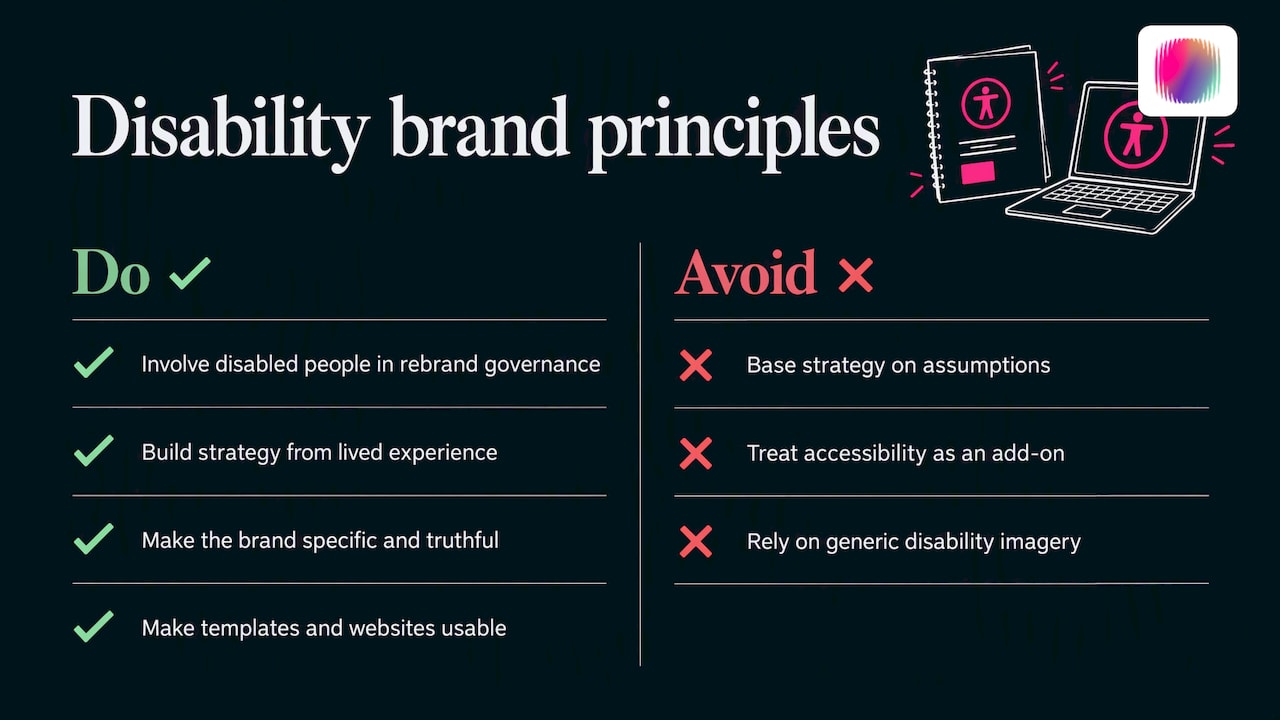
Third, a brand is a system people must be able to use. If your volunteers cannot find the templates, or your website cannot be navigated with a keyboard, the identity has failed no matter how good it looks in the launch deck.
If you take one thing from this guide, let it be this: involve people with disability in governance of the rebrand itself, not only in its imagery.
— Tommy
Working with us on your rebrand
If you want a partner for the strategy, identity, website and content, we work with disability organisations, social enterprises, startups and established businesses on brand strategy, brand design, creative assets, web development and social media, and we run DIY courses for teams building their brand in-house. You can see everything on our services page, or start from our homepage to see how we work. We do not publish prices, so the quickest way to scope your project is to get in touch.
FAQ
How do you rebrand a nonprofit?
Start with a written case and board approval, then run accessible discovery with your stakeholders. Settle strategy and naming before design, test the new identity with real users, complete legal and register updates, and launch internally before going public. Plan the first 90 days after launch as part of the project.
How long does a nonprofit rebrand take?
It depends on scope. A brand update is far quicker than a full rebrand with a name change, a new website and stakeholder consultation. Board decision-making and legal steps often set the pace more than design does. Our Australian rebrand timeline breaks down the stages.
Do we have to tell the ACNC if we rebrand?
Only if the legal name, address for service, responsible people or governing document change. If you change your legal name, notify the ACNC within 28 days if you are medium or large, or 60 days if you are small. A new logo or tagline alone does not trigger this, but check your own constitution and with your adviser.
What is the difference between a rebrand and a brand refresh?
A full rebrand changes strategy and identity together. A refresh changes mainly the visual identity, such as logo, colours and typography, while the underlying strategy stays. If your purpose and audience are unchanged, a refresh is often enough.
Why do rebrands fail?
The common causes are skipping strategy, weak board involvement, no internal owner, poor adoption and accessibility treated as a late check. Rebrands also struggle when supporters cannot see why the money was spent. Explain the reason in terms of impact and accountability.
Sources
- When to rebrand a nonprofit (BrandRaise)
- How to rebrand your nonprofit the right way (NonProfit PRO)
- 20 Strategies To Navigate A Nonprofit Rebrand (Forbes Nonprofit Council)
- Rewriting the story: navigating nonprofit brand evolution (CASE Journal, 2026)
- Hospice branding research abstract (BMJ Supportive & Palliative Care)
- Creating accessible and inclusive communications (Australian Human Rights Commission)
- Notifying the ACNC
- ACNC Corporate Plan 2021-22
- Change your charity’s ABN or legal structure (ACNC)