
Brand voice guidelines are a short, usable document that records how your organisation sounds: its personality, its vocabulary, and how its tone changes from one situation to the next. A good set fits on a few pages, gives writers rules they can apply in seconds, and stops your website, emails and social posts from sounding like they came from different organisations. This guide shows you how to build one, with a template, worked examples and a section on inclusive language for disability and nonprofit brands in Australia.
TL;DR
- Write down your values first, then choose three to five voice traits and define each with an “is / is not” boundary.
- Voice stays constant. Tone flexes with the situation, so your guide needs a tone-shifting section, not just adjectives.
- For disability and social impact brands, use plain language, presume competence, avoid “inspiration” framing, and ask the community which terms it prefers.
- Test the guide on real drafts, then roll it out with training, templates and an owner who maintains it.
- If you would rather not do this alone, we build voice and brand systems for disability organisations and social enterprises.
Table of Contents
- What brand voice guidelines are (and what they are not)
- Why it matters commercially
- Start with values, not adjectives
- The anatomy of a working guide
- Brand voice examples worth studying
- Inclusive tone of voice: what changes for disability brands
- Tone of voice for nonprofits and social enterprises
- How to create your brand voice in seven steps
- Making the guide stick
- Our perspective
- Where we can help
- FAQ
- Sources
What brand voice guidelines are (and what they are not)
A brand voice guide is the documented standard for a company’s personality, purpose and language. It is the bridge between what you believe and what a stranger reads on your homepage. It is not a visual identity guide, though it often sits beside one, and it is not a grammar rulebook, though it can include a few house rules.
The most useful distinction is between voice and tone. The Australian Government’s Style Manual frames writing style as the result of voice and tone, and says you should adjust your style to meet user needs. In practice:
- Voice is who you are. It stays recognisable everywhere.
- Tone is how you feel in a given moment. It moves.
A warm, direct organisation sounds the same whether it is announcing a grant or apologising for a service outage. The emotional delivery is very different. A guide that only lists adjectives such as “friendly, professional, passionate” misses this, and writers are left guessing.
Why it matters commercially
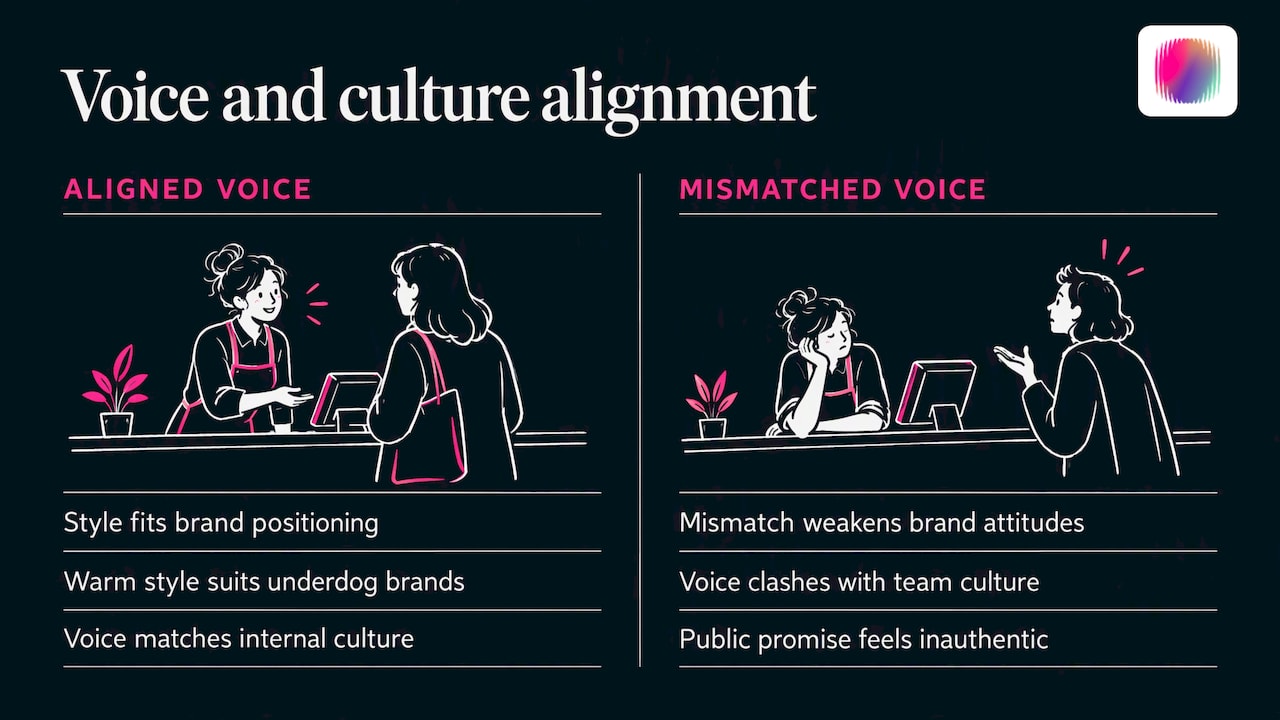
Consistency is not decoration. A study of brand positioning and conversational style, published in 2024, found that when a brand’s conversational style fits its positioning, consumers form better brand attitudes. For example, underdog brands that used a warm style did well. A mismatch between the two weakens that effect. The study looked at chatbots, but the lesson carries over to anyone who speaks for your brand: frontline staff, social media managers, freelancers and AI writing tools.
For service businesses the point is sharper. Practitioners writing about B2B service branding argue that staff are the main differentiator, so the voice has to match the internal culture, or the promise reads as inauthentic. A voice guide cannot create culture, but it can stop your public words from promising something your team does not deliver. The same idea underpins how voice consistency builds client confidence: people trust a brand that sounds like itself every time they meet it.
Start with values, not adjectives
The most common mistake is to pick a voice before you know what the organisation stands for. Adjectives chosen in a workshop at 4pm on a Friday tend to be generic. The Style Manual’s disability guidance and the experts behind it point the same way: a voice has to be rooted in core values, or it ends up hollow or contradictory.
Before you write a single trait, answer these in plain sentences:
- Why do we exist, and for whom?
- What do we believe that our sector often gets wrong?
- What do our best clients or members say about working with us?
- What would we never say, even if it raised money or won a tender?
Your answers to the fourth question often produce the sharpest guardrails in the finished guide.
The anatomy of a working guide
Several published guides, including Grammarly’s, land on a similar core: three to five behavioural traits with boundaries, audience-specific vocabulary, and rules for shifting tone. Here is a structure that holds up in real use.
1. Purpose and audience
Two or three sentences on who the guide is for and who your readers are. Name real segments: funders, families, referrers, procurement teams, job seekers. Different readers need different vocabulary.
2. Three to five voice traits, each with boundaries
Keep the list short so writers can remember it. Define each trait by what it is and what it is not, and describe the behaviour, not the mood. Grammarly’s example is to define “direct” as opening with the answer, which is a rule a writer can check.
| Trait | We are | We are not | Check on a draft |
|---|---|---|---|
| Direct | Clear, we open with the answer | Blunt or curt | Does the first sentence say the point? |
| Warm | Human, we use “you” and “we” | Chatty or sentimental | Would a person say this aloud? |
| Confident | Specific about what we do | Boastful, jargon-heavy | Is each claim backed by a fact? |
| Respectful | We presume competence | Pitying or heroic | Does it treat the reader as an equal? |
3. Vocabulary: words we use and words we avoid
Keep two short lists. Preferred terms (“members”, “clients”, “workshop”) and retired terms (“beneficiaries”, “suffers from”, “synergy”). Add a line explaining why, so a new writer can apply the logic to words that are not listed.
4. Tone map
This is the part most guides skip, and it is what makes a guide a control panel instead of an essay. List your common situations and say how the tone moves.
| Situation | Tone dial | Example move |
|---|---|---|
| Celebratory launch post | Brighter, shorter sentences | Lead with the win, thank people by name |
| Service disruption notice | Calm, plain, no jokes | State what happened, what we are doing, when you will hear next |
| Grant application | Evidence-led, structured | Numbers first, story second |
| Social reply to a complaint | Warm, direct, accountable | Acknowledge, fix, follow up privately |
5. Before and after examples
Show two or three real sentences rewritten in the voice. Examples teach faster than principles. Keep them from your own channels, so writers recognise the context.
6. Mechanics
Spelling (Australian English), date and number formats, capitalisation, how you write your own name, accessibility basics such as descriptive link text and alt text. Keep it to one page.
7. Ownership
Name the person who answers questions, approves exceptions and reviews the guide each year. Without an owner, guides drift.
Brand voice examples worth studying
Reading how others document voice sharpens your own thinking. Three public examples show different approaches:
- Government plain language. The Style Manual treats voice and tone as tools for meeting user needs, and sets out clear writing principles for the whole Australian public sector.
- Corporate content toolkit. Medibank’s content toolkit ties its voice to the master brand and places grammar and inclusive communication rules in the same reference, so writers find everything in one place.
- Product-led tone guidance. Google’s developer style guide favours a friendly, conversational tone and plain language over formal, authoritative-sounding prose.
Notice what they share: short, searchable pages, specific instructions and a focus on the reader’s understanding. Notice also what they do not need: clever slogans.
Inclusive tone of voice: what changes for disability brands
If your organisation serves, employs or represents people with disability, your voice guide carries extra weight. Every word signals whether you see people as capable adults or as objects of charity.
Presume competence, skip the inspiration story
The Style Manual’s disability and neurodiversity guidance says disability does not define people, and that you should mention disability only when it is relevant. Strong voices in this sector avoid “inspiration porn”, the habit of portraying disabled people as heroes for doing ordinary things or as victims to be pitied. Write about skills, work, ideas and outcomes. Your guide can say it outright: “We describe what someone does, not what they overcame.”
Person-first or identity-first? Ask.
This is the question that trips up most guides. Person-first language (“person with disability”) is commonly recommended in formal and government contexts. Many people, including many in the Autistic and Deaf communities, prefer identity-first language (“Autistic person”, “Deaf person”). The Australian Human Rights Commission’s page on accessible and inclusive communications is a good starting point for communicating with the community. The safest rule for your guide is not a universal one. Write: “Use the term the person or community uses for itself. If unsure, ask.”
Also steer clear of euphemisms. The Style Manual guidance recommends respectful, plain terms, and phrases such as “differently abled” are widely seen as condescending.
Plain language is an accessibility feature
Jargon excludes people with varying literacy and those who speak English as a second language. Google’s tone guidance and Australian government writing guides all push for clarity over sounding important. Build this into your traits: short sentences, one idea per paragraph, no unexplained acronyms. If you publish digital content, pair the voice guide with accessibility checks such as WCAG conformance for your website and documents; the voice and the build should both be accessible.
Tone of voice for nonprofits and social enterprises
Nonprofits face a particular tension: they need to move donors and funders, but emotional appeals can slide into pity. Social enterprises face another: they need to sound commercially credible without losing the mission. A few practical rules:
- Lead with impact and evidence. Funders and corporate buyers respond to specifics. “We placed 42 people in paid roles” beats “we change lives”, but only use numbers you can source.
- Write for two audiences at once. Your tone map should show how you speak to the people you serve, to donors, and to institutional buyers. The voice stays the same. The vocabulary shifts.
- Use “we” and “you”. It keeps the relationship between peers, not between giver and recipient.
- Avoid urgency theatre. Shock imagery and guilt language wear down trust and clash with a respectful voice.
How to create your brand voice in seven steps
- Audit what you already publish. Collect ten to fifteen pieces: homepage, an email, a grant application, two social posts, a reply to a complaint. Mark what sounds like you and what does not.
- Define values and audiences. Use the four questions above.
- Choose three to five traits. Write is / is not boundaries for each.
- Build the vocabulary lists. Pull real phrases from your audit.
- Draft the tone map. Cover your six to eight most frequent situations.
- Rewrite three real pieces in the new voice. These become your examples.
- Test with people who were not in the workshop. If a new volunteer cannot apply the guide to a draft in ten minutes, simplify it. If your community is involved, invite members with lived experience of disability to review it before it is final.
Making the guide stick
A guide nobody opens is worse than none, because it creates false confidence. Put it where people work: a one-page summary pinned in your shared drive, template email signatures, a checklist in your social scheduling process. Brief freelancers and any AI writing tools with the same rules. Review it once a year or after any major change in strategy.
If you are launching a new name or refreshing a brand, plan the voice rollout alongside the visual one. Our rebrand rollout plan and checklist covers how to find and fix the places where old messaging lingers.
Our perspective
We work with disability organisations and social enterprises, and our team includes people with lived experience of disability, among them young creatives. That shapes how we approach voice. Most disability brands we see start with the same safe, generic language and imagery. It is not wrong, but it is forgettable, and it often undersells the people behind it.
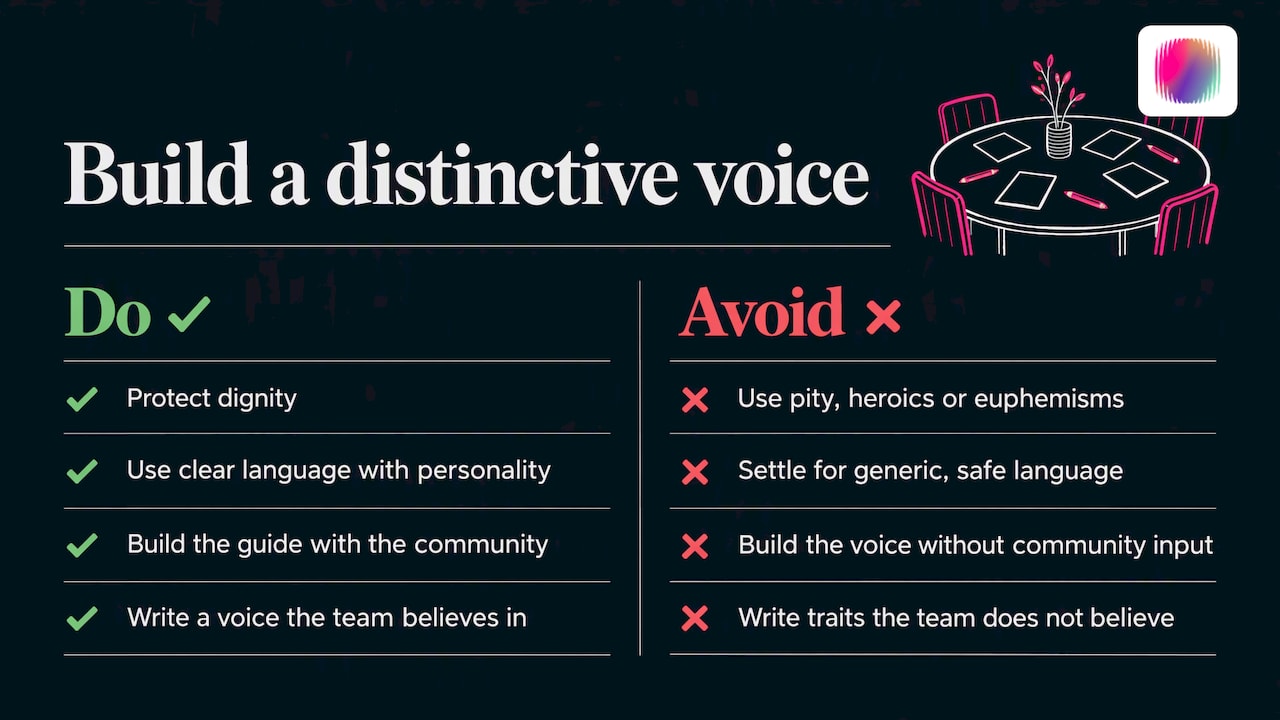
Our view is that a voice guide for this sector should do three things. First, it should protect dignity: no pity, no heroics, no euphemisms. Second, it should be distinctive. Plain language does not mean bland language, and an organisation can be clear and still have a personality that people remember. Third, it should be built with the community, not just for it. The people you describe should recognise themselves in your words.
We also think voice is only as good as the culture behind it. If the team does not believe the traits on the page, readers will feel the gap quickly. Write a voice you can live up to on a hard Tuesday, not just on launch day.
— Tommy
Where we can help
If you want a voice guide built into a wider brand system, our brand strategy, design and content services cover strategy, visual identity, web, content and social media for disability organisations and social enterprises. If you prefer to do the work in house, take a look at our brand guides and DIY courses to shape your own approach.
FAQ
What should brand voice guidelines include?
At minimum: your purpose and audiences, three to five voice traits with is / is not boundaries, preferred and avoided vocabulary, a tone map for common situations, and a few before-and-after examples. Add mechanics such as spelling and formatting, and name an owner. Keep the whole thing short enough that people will open it.
What is the difference between brand voice and tone of voice?
Voice is your consistent personality. Tone is how that personality adjusts to the situation, as the Style Manual describes. You would sound calmer in a service incident update than in a celebration post, but still like the same organisation.
How do I choose inclusive language for a disability brand?
Start with the Style Manual and Australian Human Rights Commission guidance, then ask the communities you serve which terms they prefer. Person-first and identity-first language both have strong support, so write the principle (“use the term people use for themselves”) into your guide instead of one fixed rule. Review it regularly, as preferences and terms change.
How long should a brand voice guide be?
For most small and mid-sized organisations, three to eight pages is plenty, plus a one-page summary. If writers have to hunt for answers, the guide is too long. Examples and the tone map do more work than long descriptions.
Sources
- How to Document Brand Voice Guidelines, Grammarly Business
- Voice and tone, Style Manual (Australian Government)
- Disability and neurodiversity, Style Manual (Australian Government)
- Creating accessible and inclusive communications, Australian Human Rights Commission
- Effects of interaction between brand positioning and chatbot conversational style on perceived fit and brand attitudes
- Strategic brand experience to differentiate B2B services, European Journal of Management and Marketing Studies
- Tone, Google developer documentation style guide
- Content Toolkit, Medibank