You don’t need a big budget to build a strong digital presence. You need consistency, clarity, and genuine usefulness to the people you’re trying to reach. In fact, starting cheap is ideal, make the mistakes with no budget and with low stakes. Once you’ve got the content figured out, the brand is on point and it’s just a matter of reaching more people as you grow organically – a little paid juice can be a good investment.
You need to be clear on who you’re trying to reach. Your primary audience is the person with disability – segmented within that to the specific community you serve best. Every tool, every platform, every piece of content should be evaluated against one question: does this serve that person?
The free stack
These tools cost nothing and together cover most of what a small NDIS provider needs:
- Google Business Profile: local search presence, free, must have
- Canva free: graphics and social content, accessible for non-designers
- Meta Business Suite: manage Facebook and Instagram from one place, schedule posts, view analytics
- Mailchimp free: (up to 500 contacts) – email marketing
- Google Analytics: website traffic and behaviour data
- Google Search Console: SEO performance
I considered doing mini videos on all of these but there is so much good stuff on YouTube. just make sure it’s relevant as many of these tools get updated regularly.
The minimum viable content strategy
If you can only do one thing consistently, make it this:
One piece of original content per week: a story, a practical tip, a perspective on something happening in the sector. Written for and about the specific people you serve. Posted to your primary platform, adapted for the others.
That’s 52 touchpoints per year. Consistent, on-brand, useful. More than most of your competitors. That’s the starting point and you’ll get better as you go, very few people nail this straight out the gate. You’ll look back at your first few pieces and cringe. That’s growth.
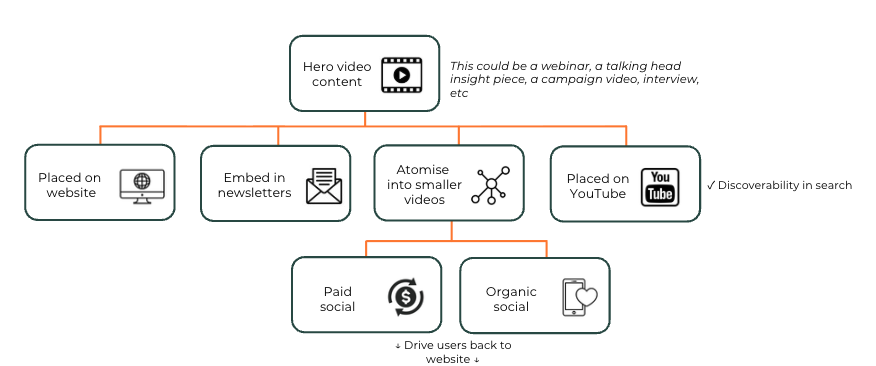
The content repurposing formula
One piece of content becomes multiple formats:
- Write a LinkedIn post (reaching secondary audiences – support coordinators, sector)
- Turn it into a Facebook post with a different intro (reaching primary community)
- Extract a key point for an Instagram graphic
- Add it to your next email newsletter
- Expand it into a blog post for SEO
Five pieces of content from one. This is the spoke-and-wheel model in its simplest form.
Accessibility is not optional
A sustainable digital presence in the disability sector is an accessible one. Captions on all video. Alt text on all images. Plain language throughout. Adequate contrast. These are not extras – they are how you actually reach your audience.
Building accessibility into your workflow from the start is faster than retrofitting it. Make it a default, not an afterthought.
Protecting your time
Batch your content creation. Set aside two hours per week to create and schedule content in advance. Don’t try to create in real time as it’s inefficient and the quality suffers.
Exercise
Plan your minimum viable content strategy. One piece of content per week. Which platform is primary for your specific audience segment? How will you repurpose it? Put it in your calendar and protect the time.