
A nonprofit value proposition is the argument for why a particular person should give, volunteer, partner or buy from you rather than someone else, or rather than not at all. It is not your mission statement and it is not a slogan. It names the problem you solve, the distinct way you solve it, and what changes as a result. This guide shows you how to write one, how it differs from a mission, how social enterprises handle it, and how it feeds the brand you are building.
TL;DR
- A value proposition is an argument aimed at a specific audience. A mission explains why you exist; the value proposition explains why someone should act.
- Test every draft on four things: appeal, exclusivity, credibility and clarity.
- A simple formula works: we solve [problem] by [unique approach], which means [outcome].
- Social enterprises carry two propositions, one for impact and one for commercial customers, and the product still has to stand on its own.
- Once the proposition is settled, carry it into your messaging, voice and visual identity so it builds brand recognition over time.
Table of Contents
- What a nonprofit value proposition actually is
- Mission vs value proposition
- The four tests every draft should pass
- A formula you can fill in today
- Writing it step by step
- Social enterprises: two propositions, one brand
- Examples from Australian organisations
- Value proposition and brand equity
- Perspective
- Work with us on your proposition
- FAQ
- Sources
What a nonprofit value proposition actually is
NextAfter describes a nonprofit value proposition as how you communicate the unique way your organisation solves a problem your donors care about, and says it belongs at the centre of your marketing and fundraising communications. The question it must answer is blunt: if I am your ideal supporter, why should I give to you rather than another organisation, or at all?
A second definition, from a City Year tool on developing a value proposition, is useful for its simplicity. It treats the proposition as two parts: the challenge or unmet need, and the approach that addresses it. If you can state those two things in plain words, you already have the skeleton.
Three things follow from this:
- It has an audience. Donors, corporate partners, government funders, volunteers, staff and clients each want something slightly different. One organisation can have one core proposition with several versions.
- It is an argument, not a description. The research behind the Why Should I Give to You? report says a value proposition is not a statement at all but an argument, the reason for taking one specific action.
- It is about distinction, not rivalry. Social Impact Architects makes a point that suits the Australian sector well: in the social sector the aim is to meet a need and create the greatest impact, not to beat another organisation. Your proposition should clarify the role you play, not claim you do everything.
Mission vs value proposition
This is where most organisations get stuck, because the two sound alike. The mission explains why you exist and is written mostly for your board and staff. The value proposition explains why a particular person should give you their money or their Saturday.
| Mission statement | Value proposition | |
|---|---|---|
| Job | Says why the organisation exists | Gives a reason to act now |
| Main reader | Board, staff, regulators | Donors, funders, partners, volunteers, customers |
| Form | A declaration | An argument with a benefit and a reason to believe |
| Changes | Rarely | Reworked per audience as needs and evidence shift |
| Test | Does it guide decisions? | Would the right person say yes because of it? |
A mission such as “to improve the lives of people with disability” could describe a very large number of organisations. A value proposition has to be narrower. It says which people, which barrier, which method and what happens next. If your organisation is still working on its purpose, our guide to a brand purpose statement that holds up is the place to start, then come back here to turn purpose into an argument.
The four tests every draft should pass
The Why Should I Give to You? research borrowed a scoring method from MECLABS built on four components: appeal, exclusivity, credibility and clarity. NextAfter uses the same four elements. Use them as an editing checklist.
- Appeal. Does the reader want this outcome? Lead with the change in a person’s life, not your internal programs.
- Exclusivity. What do you do that they cannot get elsewhere? This might be lived experience on your team, a method, a region, a community relationship or a specific population.
- Credibility. Why should they believe you? Use outcomes, years of operation, partnerships, independent evaluation or the people who deliver the work. Only claim what you can back.
- Clarity. Could someone outside your sector repeat it after one read? The same research found that organisations scoring high on clarity also scored high on appeal. Plain language is persuasive in itself.
When a draft fails, it usually fails on exclusivity. “We provide high-quality, person-centred support” is credible and clear, but nearly everyone says it. Push until you find the sentence only you could write.
A formula you can fill in today
NextAfter offers a template: Organisation name solves a problem by unique claims, which means an outcome. It is a good first draft tool because it forces you to name the problem and the result.
Here is a hypothetical illustration, not a real organisation:
Bright Path Works helps young people with disability in regional Victoria find their first job by pairing them with mentors who have lived the same barriers, which means more of them start work with confidence and stay.
Notice what the sentence does. It names the audience, the problem, a distinct method and an outcome. Now run the four tests. Appeal: yes, a first job. Exclusivity: mentors with lived experience. Credibility: this is the gap; you would add a retention figure or an evaluation. Clarity: one read is enough. That gap tells you what evidence to gather next.
The formula is a scaffold, not the finished copy. Your public wording will be shorter and warmer, and your internal version can be more precise.
Writing it step by step
- Start with the community, not the committee. The City Year guidance suggests drafting with the community members who informed your needs assessment, so the wording matches their needs. For disability organisations this is non-negotiable: the people you serve should recognise themselves in the sentence.
- Choose one audience first. Write for your most important supporter group, then adapt. A philanthropic trust wants evidence of systemic change; a monthly donor wants to feel part of something specific.
- Name the problem in their terms. Avoid sector jargon. Describe what the barrier looks like in a person’s week.
- Find your distinct claim. List what you do, then cross out anything a similar organisation could also say truthfully. What remains is your exclusivity.
- Add proof. One number, one outcome, one independent endorsement. Keep it honest.
- State the outcome. Finish with what changes, for whom.
- Test it aloud. Say it to someone outside your sector. If they ask what you mean, rewrite.
- Make it the source of your other copy. Funding applications, the website homepage, social posts and the donor email all draw from the same argument.
For funding applications in particular, the proposition should reappear in tight form in the opening summary. A good model for writing that short, decision-ready opening is this breakdown of a proposal executive summary, with examples and a template you can adapt to your own grant and partnership pitches.
Social enterprises: two propositions, one brand
If you are a social enterprise, the question “what is our value proposition?” has two answers. The Griffith University Business Model Canvas for social enterprise says a social enterprise has an impact value proposition and a commercial value proposition. The impact side is the social value you seek to deliver; the commercial side is the goods and services you sell and why customers want them. The two are linked, but separating them helps you see which customer segment each speaks to.
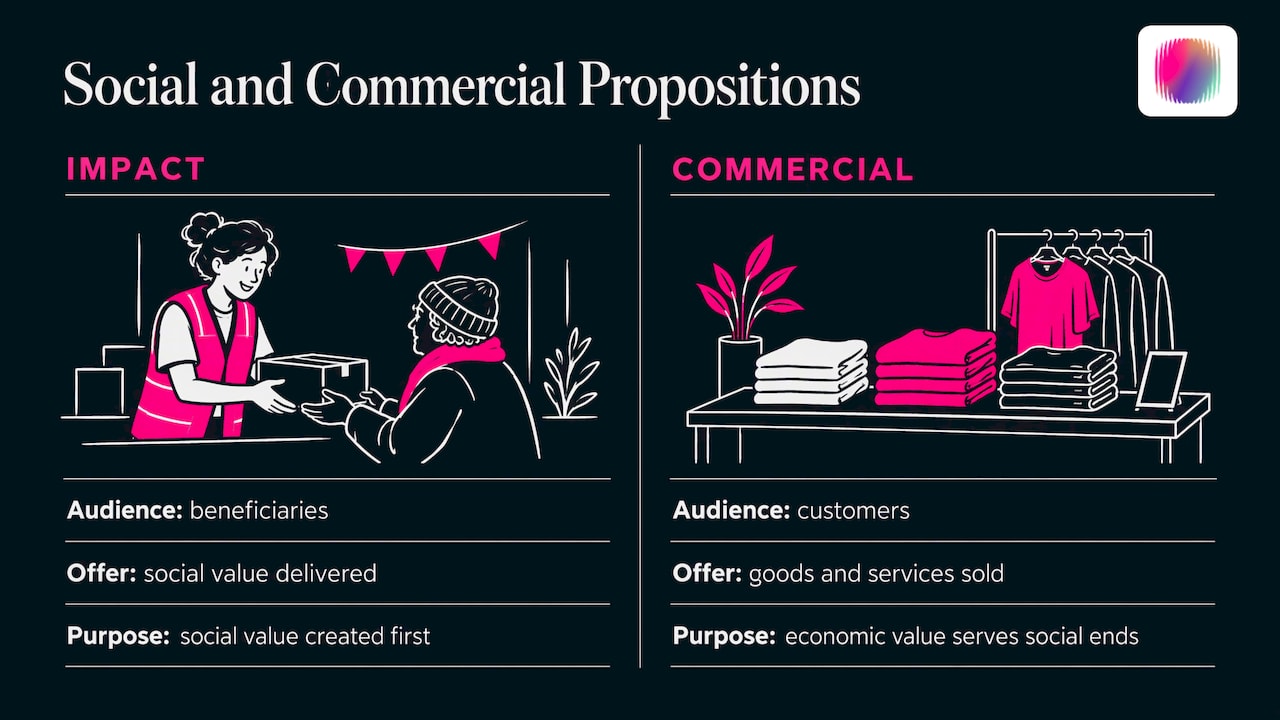
The Social Enterprise Business Model Toolkit adds that, unlike a corporate business, the value proposition must be designed for both beneficiaries and customers, with social value created first and economic value serving that end. The Social Lean Canvas frames the same split as a business model and an impact model.
The practical lesson comes from Australian operators. Amy Low, CEO of The Social Outfit, argues that standing on your own merits as a brand rather than as a good cause is key to building a work integration social enterprise that works. Customers there want clothes that fit and feel good; the impact is a bonus they value, not the reason they buy. If you sell a product or service, your commercial proposition has to win the sale before your impact story gets a chance.
There is a sector opportunity here. Curtin Social Impact research notes that Australian social enterprises are more than twice as likely to employ people with disability than other businesses. That is a distinctive, evidence-backed claim, provided your own organisation can show its part in it.
Examples from Australian organisations
Use these as prompts for how others express distinction, not as templates to copy.
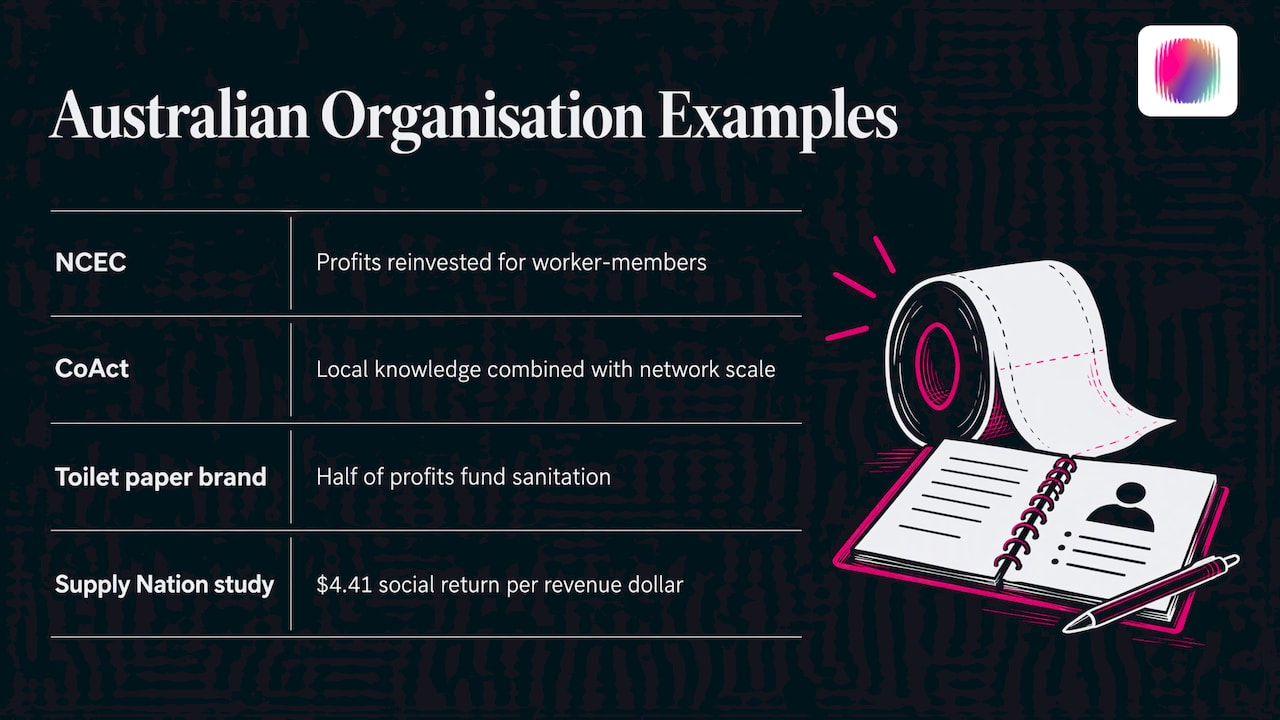
National Centre for Employment and Community (NCEC), Brisbane. This non-profit workers co-operative, established in 1998, creates inclusive employment and training for people with cognitive and psychosocial disability, measuring success on social, environmental and financial indicators. Its value lies in the structure itself: worker-members participate, and profits are reinvested for their benefit.
CoAct. Social Ventures Australia’s case studies say CoAct has kept a strong value proposition by drawing on its service partners’ local knowledge and the wider CoAct network to support jobseekers. The distinction is local expertise combined with network scale.
Who Gives A Crap. The Australian social enterprise sells toilet paper and funds sanitation work. A strategy analysis describes its customer proposition as soft, environmentally friendly paper, quirky packaging and reliable home delivery, with half of profits going to sanitation and water safety. The same piece makes a smart point about internal versus public wording: the internal proposition should be understood by everyone in the business, while public copy can be playful.
Supply Nation research. A Supply Nation study of five Indigenous certified suppliers found an average social return of $4.41 per dollar of revenue. Numbers like this show what credibility looks like when you can measure it. If you have comparable evidence, put it in the proposition.
The common thread: each names who benefits, how it works differently, and what proof stands behind it.
Value proposition and brand equity
Brand equity, in plain terms, is the recognition and trust your name carries with the people you want to reach. For a nonprofit, that shows up when a funder recognises your work in a crowded round, a donor chooses you without comparing five options, or a partner introduces you without a long explanation.
The value proposition is what that recognition attaches to. If supporters cannot say what you are known for, there is nothing for trust to build on. If they can, every touchpoint reinforces the same idea. That is why we treat the proposition as the foundation of the whole identity, not a line for the About page.
McKinsey’s work on Australia’s not-for-profit sector points the same way. It identifies a hallmark of great purpose-driven organisations as a clear purpose and meaningful values communicated across the organisation. Consistency is the mechanism: the same argument, said the same way, again and again.
Carrying it into your brand
Once the proposition is settled, put it to work:
- Messaging. Turn it into pillars and proof points with a brand messaging framework, so every writer says the same thing in different words.
- Voice. Decide how the argument sounds. Our guide to brand voice guidelines covers how to write them so staff actually use them.
- Stories. Evidence becomes memorable through people. See how to approach impact storytelling that shows real change.
- Visual identity and guidelines. Colours, type and imagery should look like your argument. Brand guidelines keep it consistent across teams and volunteers.
- Rebrand when needed. If your identity no longer matches what you do, a nonprofit rebrand is the moment to build around the new proposition.
Perspective
We have worked in branding for over 20 years, and the pattern we see in disability organisations is consistent: the work is distinctive, but the brand is not. Generic imagery and generic wording flatten a strong proposition into something that sounds like everyone else.
Our view is that the value proposition has to be built with the people it describes. Our team includes young creatives with disability, and that lived perspective changes the questions we ask. We ask what the organisation does that no one else does, and whether the people it serves would recognise themselves in the sentence.
We also think the proposition should drive creative decisions, not sit in a strategy document. When the argument is clear, the identity, the website and the social content follow with far less guesswork. That is why we start with strategy and carry it through design, content and social media.
For disability organisations and social enterprises, this is a chance to move past pity-led or tick-box messaging and present a confident, specific, positive case. That kind of clarity is what we help you reach.
Tommy
Work with us on your proposition
If you are a disability organisation, social enterprise or startup and want a value proposition that holds up in front of funders, partners and customers, we can help. Our team with lived disability experience works across brand strategy, visual identity, web design, content and social media, and we also offer DIY brand-building courses if you prefer to lead the work in-house.
See what we offer on our services page, or if you are preparing for a launch, start with our brand launch checklist.
FAQ
What is a good example of a nonprofit value proposition?
A strong one names the audience, the problem, the distinct method and the outcome in a sentence or two. The formula “we solve a problem by a unique approach, which means an outcome” is a reliable pattern. CoAct, for instance, is described as leveraging local partner knowledge and a national network to support jobseekers.
Is a value proposition the same as a mission statement?
No. The mission explains why you exist and mostly speaks to your board and staff. The value proposition gives a specific person a reason to donate, volunteer, partner or buy. You need both, and the proposition should be consistent with the mission, not a copy of it.
Does a social enterprise need a different value proposition from a charity?
Usually it needs two. The Griffith University canvas separates an impact proposition from a commercial one, since each can appeal to different customer segments. The commercial side has to work on product merit, and the impact side explains the extra value of choosing you.
How long should a value proposition be?
Aim for one or two sentences for public use, supported by proof points on your website and in funding documents. If it needs a paragraph to make sense, the idea is not sharp enough yet. Clarity matters because the research linked clarity to higher appeal with donors.
How often should we revisit it?
Review it whenever your programs, funding mix or audience shifts, and at least when you plan a new strategy cycle. Keep the core argument stable so recognition builds, and update the proof points as your results grow.
Sources
- How To Write A Unique Value Proposition For Your Nonprofit (NextAfter)
- Developing a Value Proposition (City Year)
- Why Should I Give to You? (research report)
- Social Sector Unique Value Proposition (Social Impact Architects)
- Nonprofit Value Proposition: How to Explain Why Your Nonprofit Matters (Snoika Foundation)
- Proposal executive summary: 3 examples and a template
- Business Model Canvas for Social Enterprise (Griffith University)
- Social Enterprise Business Model Toolkit
- Social Lean Canvas (Palladium)
- What a decade of The Social Outfit reveals (White Box Enterprises)
- Beyond the bottom line (Curtin Social Impact)
- NCEC case study (Community Praxis)
- Case studies of Australian field-building intermediaries (Social Ventures Australia)
- The Who Gives A Crap business model (Strategy Conversations in Practice)
- The Sleeping Giant (Supply Nation)
- Building from purpose (McKinsey)