
A brand messaging framework is a written system that sets out what you stand for, who you speak to, what you promise and how you sound, so that everyone who speaks for your organisation says the same true thing. For disability organisations and social enterprises, it also has to do something most templates ignore. It has to protect the dignity of the people you represent, and it has to be accessible to the people you want to reach.
This guide covers the seven parts of a working framework, a message house you can copy, the language decisions specific to disability, a few worked examples, and how to tell whether your messaging is doing its job.
TL;DR
- A framework has seven parts: positioning, audience, value proposition, messaging pillars, voice and tone, proof points, and a brand essence or tagline.
- A message house (one roof statement, three pillars, proof underneath) is the quickest way to put those parts on one page.
- In disability branding, language choices such as person-first versus identity-first should come from co-design with the community, not from a blanket policy.
- Accessibility belongs inside the framework: plain language, captions, CamelCase hashtags and clear access information are proof points, not extras.
- Measure it with a few simple indicators: recall, consistency, enquiry quality and community response, checked against a baseline.
Table of Contents
- What a brand messaging framework is (and what it is not)
- Why it matters more in the disability sector
- The seven parts of a working framework
- A message house you can copy
- Language decisions that are specific to disability
- Brand messaging examples: what good looks like
- How to build your framework in six steps
- Our perspective: where frameworks go wrong in this sector
- Measuring whether your messaging works
- Where we can help
- FAQ
- Sources
What a brand messaging framework is (and what it is not)
Messaging is the way a business shares what makes it special, and a clear framework keeps your voice consistent wherever you show up, as Asana’s guide to brand messaging frameworks puts it. A framework is not a tagline, a brand story or a style guide, though it feeds all three.
Think of it as the layer between strategy and creative work:
- Strategy decides who you are for and why you exist.
- The messaging framework turns that into approved words and ideas.
- Creative work (the website, the annual report, the social posts, the grant application) uses those words.
Without the middle layer, each person writes from memory. The CEO says one thing at a conference, the fundraising team says another, and the website says a third. Supporters, funders and participants notice, even when they cannot say why.
Messaging also differs from positioning. Positioning is the short statement of how you are different. Messaging is the fuller set of statements that make that difference believable in each situation. You write positioning first.
Why it matters more in the disability sector
Most brand frameworks assume the audience is customers choosing between products. A disability organisation has several audiences at once: people with disability and their families, funders and government, employers, volunteers, donors and the general public. Each needs to hear something different, and the whole must still sound like one organisation.
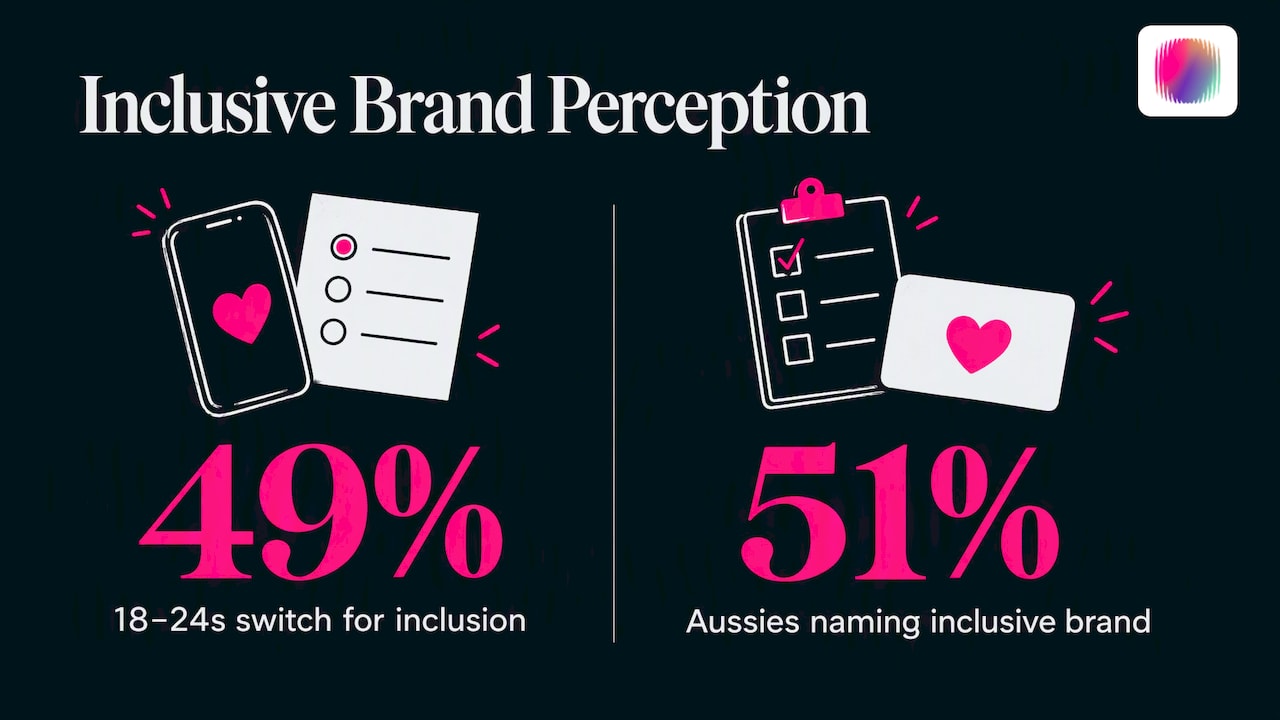
The commercial case is also growing. A Campaign Brief report on the Inclusion Imperative research found that 49% of Australians aged 18 to 24 would switch to a brand showing more inclusive representation, and that only 51% of Australians can name a brand doing disability inclusion well. For a brand that does the work properly, that gap is an opening. For a brand that relies on generic imagery and borrowed phrases, it is a risk.
The sector has a particular problem: sameness. Many organisations use the same hands-holding photography, the same words (“empower”, “journey”, “supporting you to achieve your goals”) and the same blue-and-green palette. A framework is where you decide what you will say that no one else can.
The seven parts of a working framework
Most credible guides land on the same core components. Asana lists seven: a positioning statement, target audience, value proposition, messaging pillars, brand voice and tone, proof points, and a brand essence or slogan. Here is what each one means for a disability brand.
1. Positioning statement
One or two sentences on who you serve, what category you sit in, and what makes you different. Write it for internal use. It does not need to be elegant, it needs to be specific.
Weak: “We provide high-quality support services for people with disability.”
Stronger: “We run community-based arts programs for young adults with disability who have been told the mainstream studio scene is not for them.”
The stronger version names a person, a place and a belief. You can disagree with it, which is the point.
2. Target audience
Name two or three priority audiences, not ten. For each, write what they care about, what worries them and what they need to believe before they act. Skip invented personas with stock-photo names. Use real conversations with participants, families, funders and staff.
3. Value proposition
The concrete benefit you offer and why it is better than the alternative the audience would otherwise choose. For a social enterprise, the alternative is often “do nothing” or “buy from a mainstream supplier”. Say why choosing you is better, and be specific about the outcome.
4. Messaging pillars
Three (sometimes four) themes that support the value proposition. Each pillar gets a short headline, two or three supporting sentences and a proof point. Three is a good number because people can remember it and your team can repeat it.
5. Voice and tone
Voice is who you are on the page and stays constant. Tone shifts with the situation: a warm welcome to a new participant, a precise tone in a funding submission, a calm one in a complaints response. Public-sector writing guides make this distinction explicit. The OAIC style guide notes that writing style results from voice and tone, and that you should adjust it to meet user needs.
Define voice with pairs, for example “direct, not blunt” or “warm, not sentimental”, and add a short list of words you use and words you avoid.
6. Proof points
Evidence that each pillar is true: outcomes, numbers, quotes with consent, awards, years in operation, the make-up of your team and board. For a disability brand, lived experience in leadership is a proof point if it is real. Tokenistic claims are easy to spot.
7. Brand essence or tagline
The distilled idea. Treat it as the last step, not the first. Many organisations start with a slogan and then discover they cannot explain it.
A message house you can copy
A message house is a one-page layout of the framework. Draw it, or build it as a table. Here is a structure to fill in.
| Part | What goes in it | Length |
|---|---|---|
| Roof | Your core message: the one idea you want every audience to remember | One sentence |
| Pillar 1 | Headline, supporting statement | 25 to 40 words |
| Pillar 2 | Headline, supporting statement | 25 to 40 words |
| Pillar 3 | Headline, supporting statement | 25 to 40 words |
| Foundation | Proof points under each pillar, plus values and voice notes | 2 to 3 per pillar |
| Audience notes | What changes for funders, participants, families, employers | A short paragraph each |
Aha’s overview of messaging templates describes the same logic: break the hierarchy into smaller elements such as a value statement, core concepts and proof points, then consider what your customer values. The format matters less than the discipline of keeping each box short.
A worked example
Here is an illustrative house for a fictional social enterprise, a catering business that employs people with intellectual disability. It is not a real client.
- Roof: Good food, made by a team that knows its craft.
- Pillar 1, Craft first: Every dish is judged on taste and consistency. Proof: tasting panel results, repeat corporate orders.
- Pillar 2, Real jobs, real pay: Team members are employed under award conditions with ongoing training. Proof: tenure of staff, pathways into other kitchens.
- Pillar 3, Easy to work with: Clear quotes, reliable delivery, accessible ordering. Proof: on-time delivery record, plain-language order forms.
Notice that the impact story sits in pillar two, not the roof. Customers buy catering because it is good. The social purpose strengthens the decision. It should not carry the whole message.
Language decisions that are specific to disability
Generic guides skip this section. It is where disability brands succeed or lose trust.
Person-first or identity-first
The Australian Government’s Style Manual advises focusing on the person, not the disability, and mentioning disability only when it is relevant. It also recognises that preferences differ. Some communities, such as many Deaf and Autistic people, often prefer identity-first language. So the framework should not impose one rule. Write a principle instead: we use the language each person or community uses for themselves, and we ask.
Co-design the words
The Inclusive Victoria state disability plan 2022 to 2026 recognises that there is no universal understanding of disability and treats language as a tool for changing community attitudes. The practical lesson: test your messaging with people with disability before it is final, and pay them for their time. Co-design is the method, not a consultation tick-box at the end.
Plain language and accessibility
If your audience includes people with cognitive disability, low vision or limited English, dense copy is itself exclusion. The Style Manual material on accessible content points to active voice, plain language and avoiding jargon or slang. A department writing guide from the education sector, the DfE writing style guide, sets the same goal: communicate in a way everyone can understand and put the user at the centre.
Add these checks to your framework:
- Sentences under about 20 words where possible, with one idea each.
- No acronyms without first use spelled out.
- Captions on all video, so it works with the sound off.
- CamelCase in hashtags (#DisabilityPride, not #disabilitypride) so screen readers can read each word. The ICC Sydney accessibility guide includes social media tips of this kind.
- Alt text on every meaningful image.
These are also proof points. A brand that publishes clear access information, such as step-free entry, quiet spaces and sensory maps, shows its message is true.
Avoid the imagery trap
Brand language and visuals travel together. The Houston Group rebrand for a disability support provider, covered by Creative Brands, moved away from a corporate one-size-fits-all look towards a human, approachable system, using icons drawn from everyday objects such as pens and folders. The lesson for your framework is to describe the feeling of the brand in words that designers can act on, for example “familiar, not clinical”.
Brand messaging examples: what good looks like
You do not need famous examples. You need to see the pattern. Here are three before-and-after rewrites of the kind we would expect to see in an audit. They are illustrative.
| Situation | Generic version | Framework-led version |
|---|---|---|
| Homepage headline for a disability employment service | “Empowering people with disability to reach their potential.” | “Find a job that fits your skills. We work with employers who are ready to hire.” |
| Social post for a disability arts group | “Join us for an inspiring evening celebrating diversity.” | “Doors at 6. Step-free entry, Auspan interpreters, a quiet room. Come for the art.” |
| Funding submission opener | “Our innovative holistic model delivers outcomes.” | “Of the 40 young people in our 2025 program, we can show what changed and why.” |
The common thread: the framework-led versions are specific, address a real audience, and carry proof or practical detail. None relies on inspiration language. (The last example needs your own real numbers. Never publish a figure you cannot back up.)
How to build your framework in six steps
- Audit what you say now. Collect your website, last three newsletters, a funding application and a social media month. Highlight repeated phrases and contradictions.
- Interview people. Speak to participants, families, staff, funders and a few people who chose another provider. Record the words they use unprompted.
- Write positioning. Draft three versions, then choose one in a team workshop that includes people with lived experience.
- Build the message house. Fill in the roof, three pillars and proof points. Cut anything you cannot prove.
- Set voice, tone and language rules. Include the person-first and identity-first principle, plain-language checks and the accessibility standards above.
- Test, then roll out. Show draft messages to people from each audience, adjust, then train the team. A rollout checklist helps stop the old language leaking back in. Ours is at our rebrand rollout plan.
A framework fails when it stays a marketing document. As the Asana guide stresses, it should guide the whole organisation, including sales scripts, customer service responses and internal culture. For a disability organisation that means support coordinators, intake staff and board members, not just the comms team.
Our perspective: where frameworks go wrong in this sector
We have spent more than 20 years helping brands find their own voice, and we work with a team that includes young creatives with disability. That shapes what we look for in a framework.
First, we look for borrowed language. If an organisation’s messaging could be swapped with its nearest competitor’s without anyone noticing, the framework has not done its job. Our whole approach rests on moving disability brands away from generic imagery and messaging towards identities that resonate.
Second, we look at who was in the room. Messaging written about people with disability, rather than with them, tends to read as pity or inspiration, and audiences feel the distance. Lived experience on the team changes which words get chosen and which get thrown out.
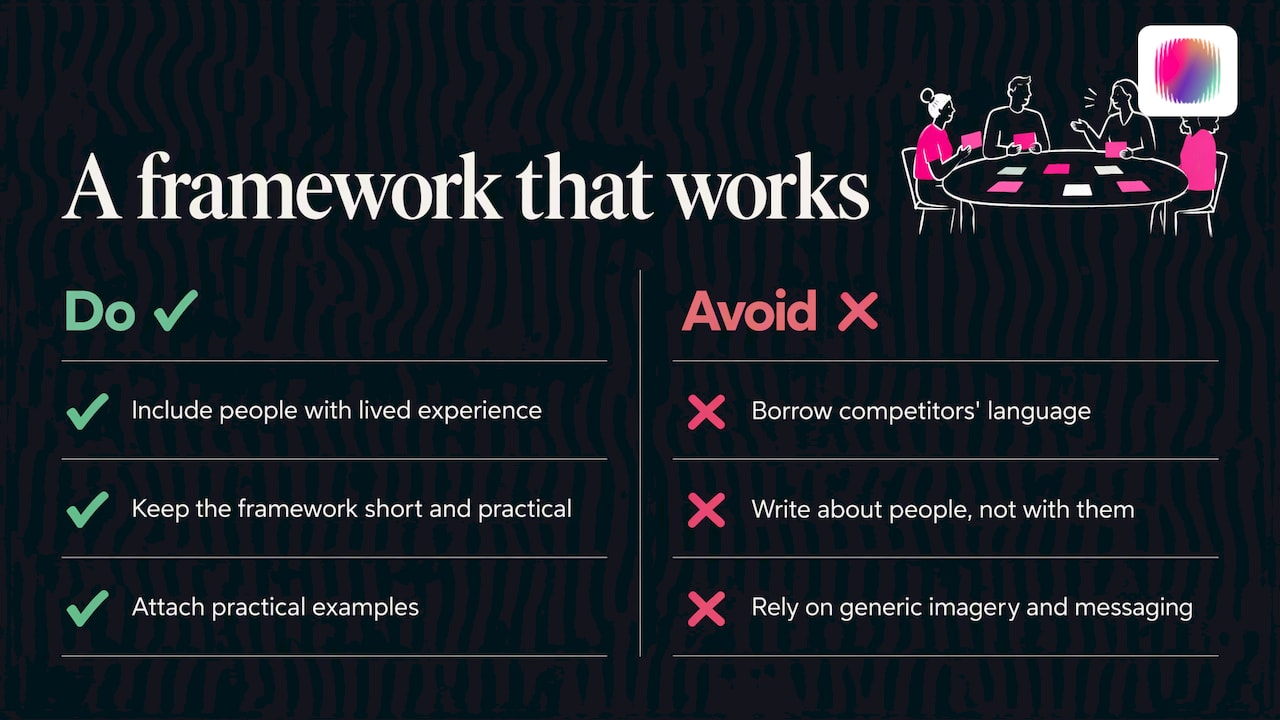
Third, we look at whether the framework can survive a busy Tuesday. If your frontline staff cannot remember the three pillars, the framework will not shape anything. Keep it short, keep it practical, and attach examples.
The opportunity is real. If few people can name a brand that does disability inclusion well, the first brand to do it with substance owns the space.
— Tommy
Measuring whether your messaging works
Brand performance measurement does not need a large budget. It needs a baseline and a short list of indicators you check on a schedule. For a nonprofit or social enterprise, a practical set looks like this:
| Indicator | How to check | How often |
|---|---|---|
| Message recall | Ask 10 to 20 supporters or participants to describe you in their own words, and compare with your roof statement | Twice a year |
| Consistency | Audit a sample of 10 recent pieces (web, email, social, a funding submission) against the pillars and voice rules | Quarterly |
| Enquiry quality | Track how many enquiries are from your priority audiences, and ask how they heard of you | Monthly |
| Engagement | Look at saves, shares, replies and comments rather than likes, and read the comments | Monthly |
| Accessibility compliance | Share of videos with captions, images with alt text, hashtags in CamelCase | Quarterly |
| Community response | Feedback from people with disability on how represented they feel | Annually |
Be honest about what you can attribute. A rewrite will not move a number on its own, and several things change at once. Record what you changed and when, then look for patterns over six to twelve months.
Where we can help
If you want the framework built with you, our team covers brand strategy, brand design, content, web and social media for disability organisations and social enterprises. See our services for what we offer. If you would rather work through it yourselves, our brand guides and online courses are designed for DIY branding. If you are planning ongoing posting, our page on social media management costs in Australia sets out expected ranges. For a first conversation, start from our home page.
FAQ
How long should a brand messaging framework be?
Two to six pages is enough for most organisations, with the message house on page one. If people will not read it, it will not be used. Put longer detail, such as audience notes and examples, in an appendix.
What is the difference between a message house and a messaging framework?
A message house is a visual summary: a roof statement, pillars and proof points. A framework is the wider document that also includes positioning, audience detail, voice and tone, and language rules. Many teams use the house as the front page of the framework.
Should we use person-first or identity-first language?
Neither as a blanket rule. The Australian Government Style Manual advises focusing on the person, but communities differ, and some prefer identity-first terms. Write a principle that you use the language each person or community uses for themselves, and ask when you are unsure.
Who should be involved in writing the framework?
A small working group of leadership, frontline staff and communications, plus people with lived experience who are paid for their input. Test the draft with each audience before you finalise it. A framework approved by one person in a meeting is the version that gets ignored.
How do we know if the framework is working?
Compare against a baseline you set before the rollout. Check recall, consistency across channels, enquiry quality and community feedback on a regular schedule. Expect gradual change over months, not weeks.
Sources
- Brand Messaging Framework: Components + 6-Step Guide, Asana
- Half of young Aussies would switch to brands with better disability representation, Campaign Brief
- Disability and neurodiversity, Style Manual
- Inclusive Victoria state disability plan 2022 to 2026
- Houston Group reimagines Plan Partners brand, Creative Brands
- Accessibility and Inclusion Guide, ICC Sydney
- Writing style guide, DfE
- Style guide, OAIC
- Marketing messaging templates, Aha!