
A brand purpose statement is one or two sentences that say why your organisation exists beyond making money, and who is better off because it does. A good one is specific enough to guide decisions, true enough to survive scrutiny, and short enough that your team can say it without looking at a slide. This guide shows you how to write one, how it differs from a mission statement, and how to back it with proof.
TL;DR
- A purpose statement answers “why do we exist?”. A mission answers “what do we do, and how?”. Keep them separate, even though many organisations blur them.
- Start from the change you make for people, not from adjectives. If a competitor could paste your statement onto their site, it is not finished.
- Purpose works when it is built into how you run the organisation first, and communicated second.
- Test every draft against three questions: is it true today, can we prove it, and does it change a decision?
- For disability organisations, the statement should be written with the people you serve, not about them.
Table of Contents
- What a brand purpose statement actually is
- Brand purpose vs mission, vision and values
- Why a clear purpose matters for brand
- Examples of brand purpose statements, and what makes them work
- How to write your purpose statement, step by step
- Making your purpose credible, not just well written
- Where a purpose statement goes
- Our perspective
- Work with us on your purpose and brand
- A quick checklist before you publish
- FAQ
- Sources
What a brand purpose statement actually is
The Conference Board describes a purpose statement as an official public document that succinctly captures a company’s “why”, and a public commitment to respond to the needs of more than one group of stakeholders. Notice the two parts: it is public, and it is a commitment. That is what separates it from a tagline, which only has to sound good.
Ipsos has framed brand purpose as a focal point that guides business decisions, benefits people’s lives and the world, and stays steady under short-term pressure. That last idea is useful. If your purpose changes every time a funding round, a grant cycle or a quarter gets tough, it was a campaign, not a purpose.
For a nonprofit, social enterprise or disability service, this sounds obvious: of course you have a purpose, it is why you were founded. In practice, though, the founding purpose is often buried in a constitution or a charity registration, and the public-facing words are generic. “Empowering people to reach their potential” could describe a gym, a bank or a school. A purpose statement is the work of replacing that with something only you could say.
What it is not
- Not a tagline. A tagline is a line of campaign copy. A purpose statement is the reason behind the copy.
- Not a list of values. Values describe how you behave. Purpose describes why you exist.
- Not a fundraising pitch. It can inform one, but it should be true even when no one is being asked for money.
- Not a slogan about being “inclusive”. Say who is included, in what, and what changes for them.
Brand purpose vs mission, vision and values
These four terms get swapped constantly. Melbourne Business School’s 2025 report on enacting purpose in Australia sets them out in plain terms: purpose is why an organisation exists, values are how it behaves, mission is what it does day to day, and vision is the impact or future it strives for.
The Conference Board also notes that, in practice, companies often use purpose and mission interchangeably, even though the two are distinct in theory. So if you have a mission statement that already reads like a purpose, you may not need a new document. You need to check that it answers the “why”.
| Element | Question it answers | Time frame | Example of the form |
|---|---|---|---|
| Purpose | Why do we exist? | Enduring | “So that every person with disability can …” |
| Mission | What do we do, and for whom? | Now | “We design and deliver …” |
| Vision | What future are we working towards? | Long term | “A country where …” |
| Values | How do we behave? | Always | “Nothing about us without us” |
One way to sense-check: a mission can be completed or measured by activity (programs delivered, sites built). A purpose is never finished. You can always serve it better.
A mission statement is closer to a strategic roadmap, while a purpose statement is the philosophical motivation for existing. If you have only one sentence to spend on your homepage, spend it on purpose, and let your services pages carry the mission.
Why a clear purpose matters for brand
Wharton researchers argue that brand purpose should connect people with each other, their communities and the wider world, going beyond the brand’s profits. For a disability organisation, that connection is the whole point. Your audiences include people with disability, families, funders, referrers, employers and the general public, and each needs to see themselves in the same story.
A clear purpose helps in practical ways:
- It shortens decisions. When a partnership, campaign or service is proposed, you can ask whether it serves the purpose. If it does not, the answer is easier.
- It unifies messaging. Social posts, grant applications, the website and the annual report start to sound like one organisation. Our guide to a brand messaging framework shows how purpose sits at the top of the messages that follow.
- It attracts the right people. Staff, board members and supporters who share the reason you exist stay longer and advocate harder.
- It differentiates. In a sector where imagery and language have become very similar, a specific purpose is one of the few things a competitor cannot copy.
Examples of brand purpose statements, and what makes them work
Generic lists of 40 statements rarely teach anything. A better approach is to look at a few and ask what each does that the others do not.
Patagonia. The company’s public ownership page says that its profits now go to fighting the climate and extinction crisis, with a purpose trust created to protect the company’s values and mission. What makes this credible is structure. The purpose is not only worded; it is written into who owns the business. Most organisations cannot copy that, but you can copy the principle: let the purpose show up in a decision that costs you something.
Who Gives A Crap. The Australian toilet paper brand donates 50 percent of its profits to build toilets and improve sanitation, according to a purpose-driven marketing guide that profiles it. The purpose is easy to repeat, tied to a measurable commitment, and visible on the product. It is a good model for a social enterprise: one problem, one number, one place to look for proof.
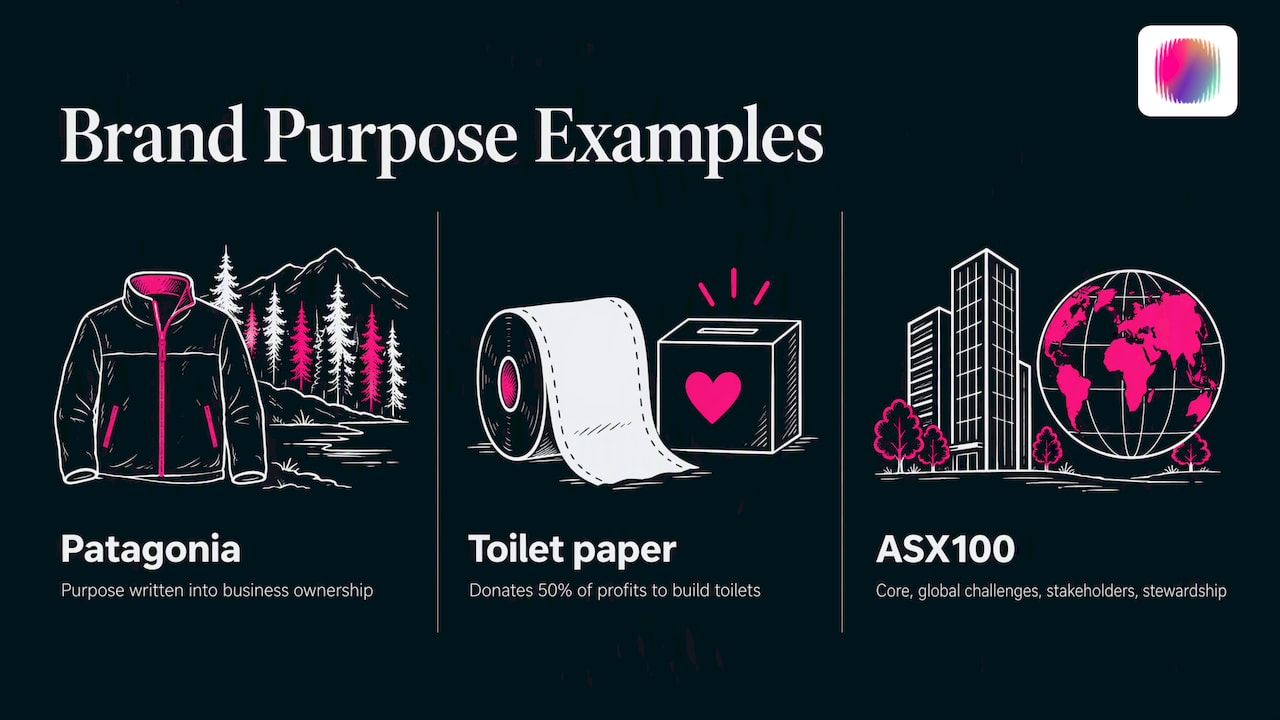
Large Australian listed companies. Griffith University’s review of ASX100 purpose statements is a useful benchmark. It says an actionable purpose statement should connect the business’s core to global challenges, reference a broad set of stakeholders, and reinforce stewardship. Those three tests work just as well for a small organisation, scaled down to your own community.
What the strong ones share
- They name a specific change for a specific group.
- They are tied to something checkable: a profit share, a governance structure, a published result.
- They avoid abstract nouns such as “excellence”, “solutions” and “empowerment” doing all the work.
- They are short enough to remember.
A before and after, using a made-up disability organisation
This is an illustration of the method, not a real client.
Before: “We empower people with disability to live their best lives through innovative, person-centred support.”
After: “We exist so that young people with disability get to make the decisions about their own lives, starting with the ones adults usually make for them.”
The second version is longer on specifics and shorter on buzzwords. It names who, it names a change, and it implies what the organisation will do differently: hand over decisions. You can now test it. Do your programs actually let young people decide? If not, fix the program, not the sentence.
How to write your purpose statement, step by step
1. Start with the change you make
Write down, in plain words, what is different in someone’s life because you exist. Use real situations. “A 17-year-old gets her first paid job” is better than “improved employment outcomes”. Collect ten of these from case notes, feedback and staff.
2. Ask the people you serve
Sector credibility depends on this step. Run a short session with participants, families and staff with lived experience, and ask what they would say you are for. Their words are often sharper than the board’s. If your audience includes people with different access needs, plan for it: captions, plain-language summaries, quiet rooms, and more than one way to contribute.
3. Find the pattern
Highlight repeated ideas. You are looking for a verb, a group of people and an outcome. Throw out anything that would also fit your closest alternatives.
4. Draft three versions
Write a short one (under 15 words), a medium one (one sentence) and a longer one (two sentences with a “so that”). Read each aloud. The one that sounds like a person speaking usually wins.
5. Apply the Griffith tests
Check your draft against the three ASX100 criteria above. Does it connect to a broader issue, such as employment, housing, representation or access? Does it include everyone you serve, not only the loudest audience? Does it commit you to looking after something over time?
6. Embed before you broadcast
Trellis advises that purpose is most effective when it is a management strategy linked to tangible goals and embedded in culture before being communicated externally. In practice: brief your team first, adjust your onboarding, link it to your annual plan, and only then update the website and social channels.
7. Turn it into language people use
A purpose statement is the top layer. Beneath it you need tone and vocabulary rules so everyone writes in the same way. That is the job of brand voice guidelines, and of a wider set of nonprofit brand guidelines that show how the purpose appears in design, imagery and layout.
Making your purpose credible, not just well written
Trellis warns that “purpose” has become an all-purpose word in sustainability and CSR, with a risk of misuse similar to greenwashing when it is not backed by a management strategy. The Conference Board found that only 35 percent of the corporate purpose statements it studied contained ESG-related language, while the rest were more generic. Most statements, in other words, say little that can be checked.
That is your opening. A few habits keep a purpose honest:
- Claim what you do, not what you hope. “We work towards” is honest. “We have transformed” needs evidence.
- Attach proof to each claim. A number, a participant story told with permission, a governance fact, a published report.
- Show it in your own behaviour. If your purpose is about inclusion, your website should meet accessibility standards, and your hiring and procurement should reflect it. Our WCAG 2.2 checklist and guide to neuroinclusive design cover the practical side.
- Be ready for hard questions. Purpose claims get tested when something goes wrong: a complaint, a funding dispute, a media enquiry. Reading a guide to litigation communications before that day is far cheaper than improvising during it.
- Update the proof, not the purpose. The statement stays; the evidence beneath it should be refreshed every year.
Where a purpose statement goes
Once it is settled, put it where decisions and first impressions happen:
- The homepage and About page, in the first screen
- Grant and tender applications
- Board papers and strategic plans
- Staff onboarding and position descriptions
- Social media bios and pinned posts (see our Instagram guide for nonprofits)
- Email signatures and annual reports
If your organisation is also changing its name, logo or look, settle the purpose first. It is the brief for everything else. Our nonprofit rebranding guide and rebrand rollout plan show the order of work, and a naming workshop is much easier when the purpose is already agreed.
Our perspective
Most of the disability brands we meet already have a strong purpose. It is in the founder’s story, the way staff talk about participants, the reason the doors opened. What is missing is the translation. The website says “inclusive, person-centred, empowering”, and the reader cannot tell one organisation from the next.
We think the fix starts with who is in the room. Our team includes young creatives with disability, and that changes the draft. When people who live the experience read a purpose statement, they spot the soft phrases quickly. They ask “empowering how?” and “who decided that?” Those questions make the statement better.
Our advice is to treat purpose as a design brief, not a slogan. Write it plainly, prove it, and then let the visual identity, voice and content carry it. A purpose that lives only in a document is decoration. One that shapes your messaging, your imagery and your social presence is a brand.
Tommy
Work with us on your purpose and brand
If you want a purpose statement that reflects your organisation and then flows into your messaging, identity and content, that is what we do. We work with disability organisations, social enterprises, startups and established businesses on brand strategy, visual identity, web design, content and social media, and we also run DIY courses for teams who want to build the work in-house. You can see everything on our services page.
If you are not sure where to begin, start at disbranded.com.au and tell us what your organisation is for. We will take it from there.
A quick checklist before you publish
- Can a new staff member explain it in their own words after one read?
- Does it name who benefits and what changes for them?
- Could a competitor use it unchanged? If yes, sharpen it.
- Is every claim in it true today?
- Do you have at least one piece of proof for each claim?
- Did people with lived experience help write or review it?
- Is it available in accessible formats: plain text, screen-reader friendly, and easy-read where relevant?
- Is there a named person responsible for keeping it alive?
FAQ
What is the difference between a brand purpose and a mission statement?
Purpose is the reason you exist. Mission is what you do each day to act on it. Purpose is philosophical and enduring, while mission is action-oriented and can be measured by activity. Many organisations blur the two, so check that your statement answers “why” before you call it a purpose.
How long should a brand purpose statement be?
One sentence, ideally under 25 words, and often much shorter. If it needs a paragraph, you are probably describing your mission or your services. You can write a longer supporting paragraph that explains the thinking, but the statement itself should be easy to say aloud.
Does a small organisation need a purpose statement?
Yes, and it can help a small team more than a large one, because there are fewer people to align and every decision counts. It also gives funders, partners and staff a quick way to understand what makes you different. Start with the change you make for people and build from there.
What is purpose-led branding?
It is a way of building a brand where the purpose drives the messaging, visuals and behaviour, rather than being added at the end. The purpose is written first, embedded in how the organisation runs, and then expressed consistently across voice, design and content.
How often should we update our purpose statement?
Rarely. A purpose should be stable, and it is the supporting proof that needs regular refreshing. Revisit it if your organisation changes who it serves, merges, or finds that the statement no longer describes what you actually do.
Sources
- Corporate Purpose: A Primer for Marketing & Communications, The Conference Board
- Brand Purpose, Ipsos
- Enacting Purpose in Australia, Melbourne Business School
- Purpose or mission statement: which one should you create?
- How Defining a Brand Purpose Can Build Consumer Trust, Wharton
- ASX100 Purpose Matters, Griffith University
- What’s the purpose of ‘purpose’? Trellis
- Earth is now our only shareholder, Patagonia
- What is Purpose-Driven Marketing? Green Socials
- Litigation Communications: A Guide for Leaders and Counsel