
Impact storytelling is how an organisation shows the change its work creates, using real people’s experiences backed by evidence. Done well, it earns trust from funders, partners and communities. Done badly, it turns people into props and leaves readers unconvinced. This guide covers what a credible impact story contains, how to get consent and represent people with dignity, which formats suit which audience, and how to tell whether your stories are working.
TL;DR
- An impact story pairs a person’s own account of change with evidence that the change happened. Neither works alone.
- Use a clear arc: why the problem matters, what was done, what changed, and what you learned.
- Consent must be informed, freely given and documented before you collect anything. Present people as agents of change, not victims.
- Match the format to the audience: a funder report, a short video and a social post need different cuts of the same story.
- Decide what you want a story to change before you publish it, then check whether it did.
Table of Contents
- What impact storytelling actually is
- What makes an impact story credible
- How to write an impact story, step by step
- A worked example of the structure
- Consent and dignity: the non-negotiables
- Formats: one story, many cuts
- Telling the story the way each funder reads it
- How to tell whether your storytelling is working
- Our perspective: stories are brand work
- Where we can help
- FAQ
- Sources
What impact storytelling actually is
The Western Australian Community Impact Hub describes social impact storytelling as a way to communicate the outcomes, learnings and insights of your work by combining data, evidence and personal narratives. The aim is to drive positive change and inspire action, going beyond dry reporting.
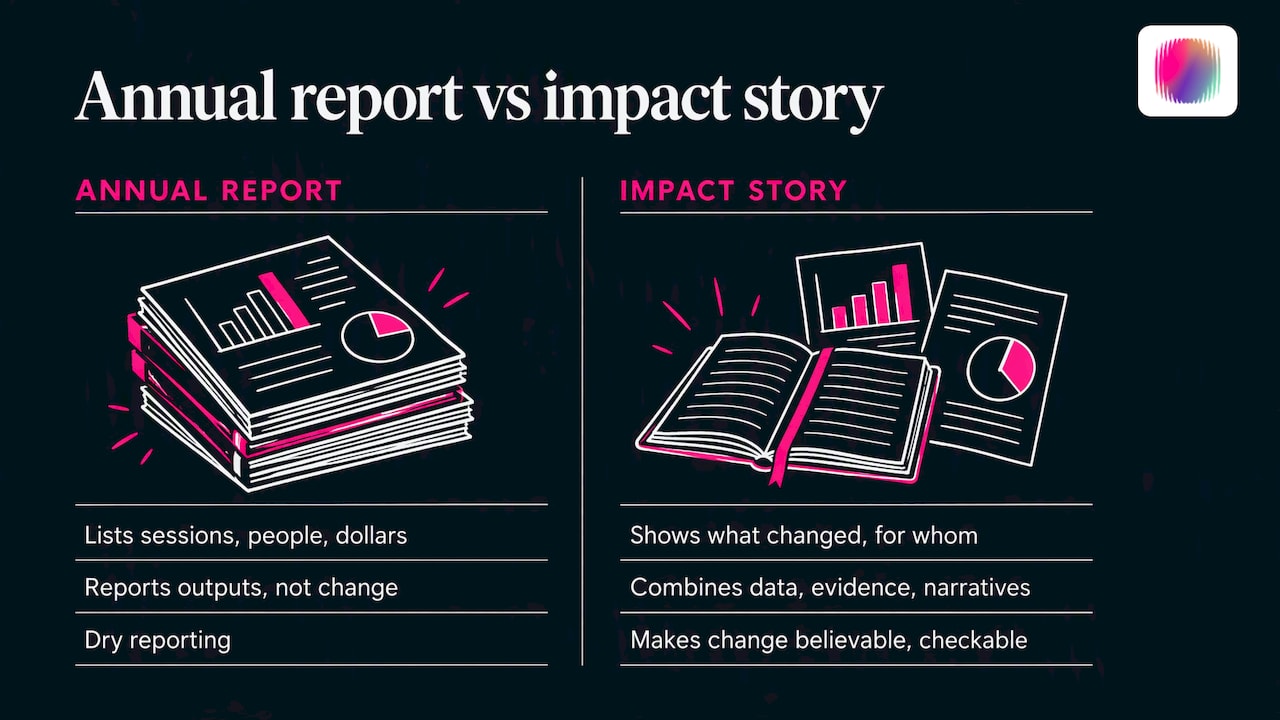
That last point matters. An annual report lists outputs: sessions delivered, people reached, dollars spent. An impact story answers the question a reader actually has: so what changed, for whom, and how do you know?
Storytelling more broadly works because narrative connects emotionally and makes a message memorable. The Internet Society Foundation lists inspiring action and learning among the objectives of storytelling for impact. Researchers working on digital storytelling add that a told story invites listeners to build images, characters and events in their own minds, becoming co-creators of what they hear.
A useful working definition for your team: an impact story is a real experience of change, told so the reader can believe it and, where possible, check it.
Impact stories versus case studies, testimonials and vignettes
These get mixed up constantly, and the difference shapes what you write.
- Testimonial: a short endorsement. “This program changed my life.” Warm, but it proves little.
- Profile or vignette: a snapshot of a person. Annie Neimand, writing in Stanford Social Innovation Review, argues that many organisations share profiles and vignettes rather than stories with a beginning, middle and end, conflict and resolution, characters and settings.
- Case study: a structured account of one situation, often with more analysis and less emotion.
- Impact story: a narrative with a character, a turning point and evidence that links the change to your work.
You will still use all four. Know which one you are writing.
What makes an impact story credible
Credibility is the whole job. A moving story that a funder cannot trust is worse than none.
Pair the story with evidence
UNICEF’s evaluation team puts it bluntly: impact is about measurable change in people’s lives, and that has to be supported by solid evidence rather than anecdotes alone. Capacity Canada gives the same practical advice: stories should not be the only source for interpreting impact, and surveys or third-party reports are needed too.
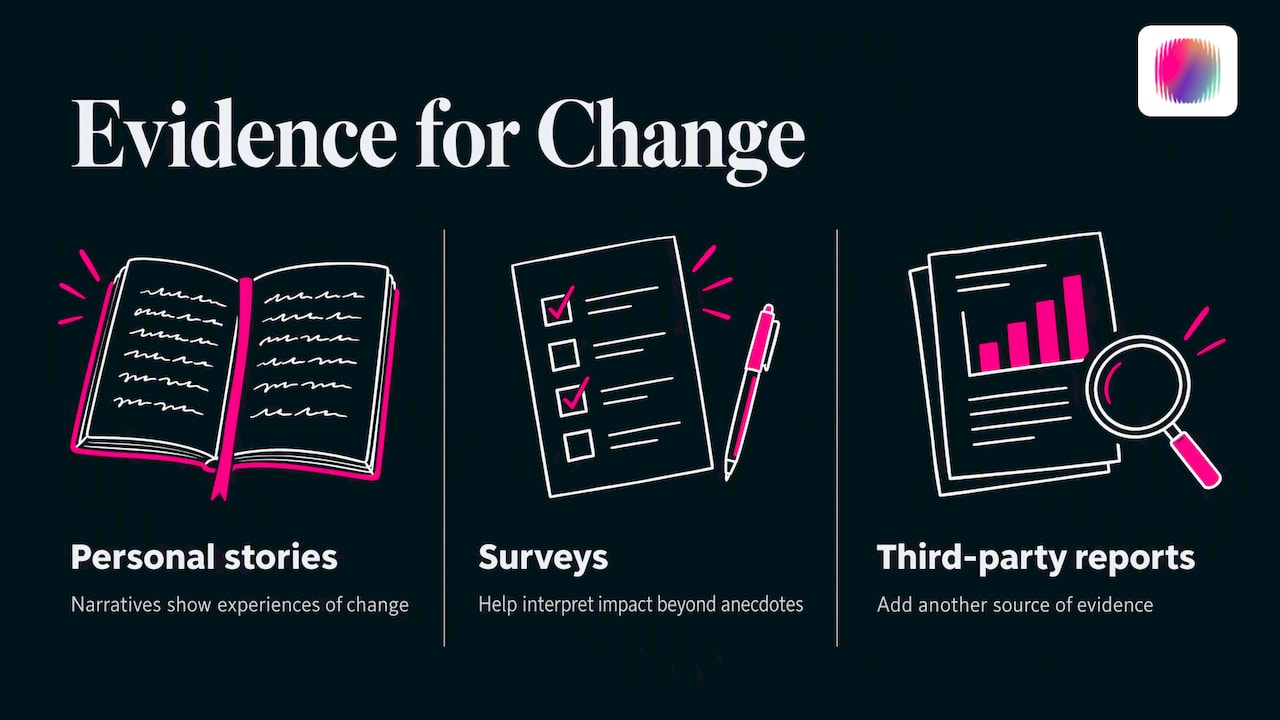
An academic framework for telling the story of complex change recommends a mixed-method approach, with a rich range of triangulated evidence behind the change you describe, and no “narrative-free data”. Its authors also suggest focusing on learning, not only accountability. That is a good instinct: stories that admit what did not work read as more honest.
The Australian Institute of Company Directors notes that impact reports can use narrative and numerical descriptions of impact, tailored to the intended audience. Board members and funders often want both on the same page.
Include lived experience properly
The Centre for Social Impact’s roadmap says that engaging people with lived experience, through co-design or advisory groups, enhances the credibility and relevance of impact evaluation. It describes lived experience as first-hand knowledge gained through direct involvement, which supplies context that traditional data collection often misses.
In practice, this means the person in the story is not only a subject. They help decide what is said, how it is framed and whether it is accurate.
A quick credibility checklist
Before a story goes out, ask:
- Can every claim about change be traced to a record, a survey result, a service log or a third-party source?
- Is the person’s own voice used, with their approval of the final wording?
- Does the story say what you did, not just what happened to them?
- Is there something in it that did not go to plan?
- Would the person be comfortable with this story being read by their family, employer or community?
How to write an impact story, step by step
You do not need a long process. You need a disciplined one.
1. Name the change you want to show
Write one sentence: “Before our work, X. Afterwards, Y.” The Western Australian Community Impact Hub says an effective impact statement should articulate the purpose of the initiative and the change intended, while an impact summary gives a concise overview of key findings. If you cannot write your sentence, you are not ready to choose a story.
2. Choose the story, then the evidence
Pick stories because they illustrate a pattern in your data, not because they are the most dramatic. A single exceptional outcome presented as typical will not survive a funder’s questions. Where it is exceptional, say so.
3. Get consent first
Covered in detail below. It comes before the interview, not after the edit.
4. Build the arc
The Internet Society Foundation describes an effective arc this way: a beginning that explains why the problem matters and introduces a character, a middle showing the intervention’s trajectory, and an ending that demonstrates the solution and its positive effect.
AMES Australia’s guide to writing a story of change lists these components: a title, the situation or issue, the intervention, the outcomes, reflections on key learnings and a clear call to action. It is a handy template to adapt.
5. Let the person speak
Use their words where you can. Paraphrase only to shorten, and send the draft back for approval. A story written about someone, rather than with them, usually reads that way.
6. Add the proof
Place the number or record beside the human moment. For example: a participant’s description of getting a first job, next to the proportion of program graduates who gained employment, with the survey method named. Keep the figure’s source and date visible.
7. Close with learning and a next step
Say what you learned, then tell the reader what to do: donate, refer, partner, read the full report.
A worked example of the structure
This is an illustration of structure, not a real case.
Situation: A regional peer-support group notices that new members with disability often stop attending after two sessions.
Intervention: The group asks members what is getting in the way, redesigns the first session with them and adds a named buddy.
Outcome: Attendance past the third session rises, measured from sign-in sheets, and a member describes in her own words what the buddy changed for her.
Learning: The buddy system works for most, but did not help members who find group settings difficult, so the group is trialling one-to-one options.
Call to action: Local services are invited to co-run buddy training.
Every element is checkable, the person has a voice, and the limitation is stated. That is what makes it credible.
Consent and dignity: the non-negotiables
This is where organisations in the disability sector, and every other sector working with people, are most exposed.
The Centre for Social Impact’s roadmap says consent should be informed, freely given and documented before content is gathered, and recommends a strengths-based approach that rejects stereotypes and treats contributors as active agents of change rather than victims. It also explains that incorporating lived experience is essential for ethical engagement because it respects the dignity and agency of the people involved.
Caritas Australia’s ethical storytelling guidelines are specific: informed, freely given and prior consent must be documented before photos or videos are taken. The same guidelines say the organisation rejects stereotypes and white saviour language and presents participants as active agents of their own transformation.
What this means in practice
- Explain the use. Tell the person where the story will appear, for how long, and who might see it, in a format they can access: plain language, Easy Read, interpreter, or a support person present.
- Separate consent from service. Make clear that saying no has no effect on the support they receive.
- Let them review. Offer a draft before publication and a way to withdraw later.
- Avoid inspiration framing. If the story only works because a reader feels sorry for or amazed by someone, rewrite it around what they did and what they want.
- Credit and pay where you can. Contributors are doing work for you. Recognise it.
If your story involves a person who may have difficulty understanding the consent process, or involves a minor, work with their supporter or guardian and your organisation’s own safeguarding policy before you proceed.
Formats: one story, many cuts
The Getting Further Faster toolkit lists many ways stories can be shared: video, audio, photographs, text, social media, reports, newsletters, emails, meetings and infographics. It also points to story arcs and collective storytelling, where multiple voices and stakeholders are woven into one narrative.
A simple way to plan is to build one full story and cut it down:
| Audience | Format | What to lead with | Evidence level |
|---|---|---|---|
| Funders and boards | Report section, one-page summary | Outcome and evidence | Full: data, method, limitations |
| Government and partners | Case summary, short presentation | Change at scale, then one person | Medium to full |
| Community and supporters | Short video, newsletter, email | The person and the turning point | Light: one or two headline figures |
| Social media followers | Photo, quote tile, 30-second clip | One moment, one line of change | Minimal, with a link to the full story |
If you publish on Instagram, our guide to Instagram for nonprofits covers how to adapt this kind of material for the platform. The same story will also sound more coherent across formats if your organisation has a clear brand voice that writers and contributors can follow.
Choosing between stories of one and stories of many
One person’s story gives emotional force. A collective story, with several voices around one theme, gives weight and protects against the “exceptional case” objection. Many strong reports use a collective frame, then zoom in on one voice.
Telling the story the way each funder reads it
Trust and grant funders, corporate partners and government agencies read differently. Funders usually scan for outcomes, then evidence, then risk. Corporate partners often look for alignment with their own values and a story they can share. Individual donors respond to people first.
The AICD’s point about tailoring narrative and numbers to audience applies here. Keep a single master version with all the evidence, then cut to what each reader needs. Never change the facts between versions, only the emphasis.
How to tell whether your storytelling is working
Most organisations publish stories and never check what they did. A better approach costs little.
- Set the intended change before publishing. Is the aim understanding, engagement, a referral, a donation, a policy conversation, a shift in how people talk about disability? Pick one primary aim per story.
- Choose a matching signal. Understanding might be a short reader poll or a question on a feedback form. Engagement might be shares, replies and time on page. Action might be enquiries, sign-ups, referrals or donations traced to the story with a link or code.
- Compare against a baseline. Look at what a similar post, email or page achieved before. One result means little; a pattern across several stories means more.
- Ask the people involved. Did the contributor feel represented accurately? Did people in their community respond well?
- Ask your audience directly. A one-question survey to supporters or funders (“what did you take from this story?”) tells you more than a click count.
- Record what you learn. Add it to your next story’s planning, in the same learning-first spirit the Impact Framework authors recommend.
Be modest about what you claim. A rise in enquiries after a story is a sign, not proof, that the story caused it.
Researchers at UCL describe the impact storytelling field as moving from fluid to formalising, with a need for better alignment of terms, attention to skills gaps and redress of power imbalances. For small organisations, that is a reminder that agreed ways of measuring story effect are still developing, so write down your own method and stick to it.
Our perspective: stories are brand work
We have spent more than 20 years in creative and brand work, and our team includes young creatives with disability. From that vantage, the most common problem we see in the disability sector is not a lack of stories. It is that stories arrive wrapped in generic imagery and familiar messaging: the smiling person in a wheelchair, the triumph-over-adversity arc, the stock photo that could belong to any charity.
Those choices are brand choices. They tell the reader who the organisation thinks the audience is, and who it thinks the people it supports are. When the story is written from the organisation’s point of view rather than the contributor’s, the brand sounds like everyone else, and the person disappears.
So we think of impact storytelling as three layers that need to agree:
- Who you are: your positioning and what you stand for.
- How you speak: a voice that lets real people’s words sit comfortably beside your own. Our brand messaging framework guide shows how to set this up for disability brands.
- What you show: imagery and design that reflect people as they are, chosen with them.
When those agree, a story needs less decoration. The change is visible, the person is in charge of their own narrative, and the evidence does the persuading. When they do not agree, no amount of emotional writing rescues it.
— Tommy
Where we can help
If your organisation has the stories and the evidence but they are not landing, the gap is often identity: a brand that still sounds generic. We work with disability organisations, social enterprises, startups and established businesses on brand strategy, visual identity, web design, content and social media, and we run brand-building courses for teams who prefer to do it themselves. Our team has lived disability experience, so contributor consent, dignity and representation are part of the brief, not an afterthought. See what we offer on our services page, or start from our home page.
FAQ
What is impact storytelling?
It is telling a real experience of change in a way readers can believe, combining personal narrative with data and evidence. The goal is to show the outcomes and learnings of your work and encourage action, rather than just list activities.
What should an impact story include?
A clear situation, the intervention, the outcome, the person’s own voice, supporting evidence, a reflection on what you learned and a call to action. AMES Australia’s guide to stories of change uses much the same list, and it works for most organisations.
How do you get consent for an impact story?
Make sure it is informed, freely given and documented before you collect any words, photos or footage. Explain where and how long the story will be used, offer accessible formats, let the person review the draft, and give them a way to withdraw.
Is a story enough to prove impact?
No. Stories illustrate change, but funders and evaluators expect other evidence alongside them, such as surveys, service data or third-party reports. Use the story to make the evidence human and the evidence to make the story believable.
How do you know if an impact story worked?
Decide beforehand what it should change, such as understanding, engagement or action, then track a matching signal and compare it with your usual results. Ask the contributor and a sample of your audience for feedback too.
Sources
- 101: Sharing an impact story that packs a punch, Western Australian Community Impact Hub
- Storytelling for Impact, Internet Society Foundation
- Using Digital Storytelling for Impact and Change Measurement, Narratives of Impact
- Best Practices for Telling Better Stories About Impact, Stanford Social Innovation Review
- The real story of impact is not the one we tell, UNICEF Evaluation
- Stories Worth Telling, Capacity Canada
- Telling the story of complex change: an Impact Framework
- Impact measurement and governance, AICD
- Roadmap to Social Impact, Centre for Social Impact
- How to write a story of change, AMES Australia
- Ethical storytelling guidelines, Caritas Australia
- Impact Storytelling toolkit, Getting Further Faster
- Impact Storytelling: the Ecosystem, the Evidence and Possible Futures, UCL