
Instagram works for a nonprofit when it is treated as a two-way channel with a clear brand behind it, not a noticeboard. Set up a professional account, post a small amount of content consistently, lean on short video, and keep your fundraising claims and your photos of real people inside Australian rules. This guide covers each of those steps, with the Australian detail that most overseas guides miss.
Most advice ranking for this topic is written for US charities. Some of it, such as the 501©(3) requirement for Instagram’s donation tools, simply does not apply here. Below we cover what does apply to an Australian charity, social enterprise or disability organisation.
TL;DR
- Switch to a professional account, choose the Nonprofit category and put one clear call to action in your bio.
- Plan for two feed posts a week, Stories through the week and one or two Reels, then adjust to your capacity.
- Say whether you are a Deductible Gift Recipient (DGR) in every fundraising asset. Social media does not make a donation tax-deductible.
- Treat images of people as sensitive personal information, especially when they show disability. Get informed, express consent first.
- Strong visual identity and a distinct voice matter more than trends. Skip any trend that does not fit your cause.
Table of Contents
- Set up the account properly
- Decide what Instagram is for
- Build a brand people recognise before they read
- What to post and how often
- Making Reels that work
- Accessibility is part of the brand
- Fundraising on Instagram, the Australian way
- Photos, consent and privacy
- Perspective: why generic Instagram does not work for disability brands
- Build your channel with a team that knows the sector
- A simple 90-day plan
- FAQ
- Sources
Set up the account properly
The basics are quick. Download the app, sign up with an email or phone number, then switch to a professional account in Settings. That unlocks analytics, contact buttons and a category label. Choose Nonprofit so people understand your purpose at a glance.
A few choices are worth making deliberately:
- Profile picture: use your logo, cropped to sit well inside a circle. If your logo falls apart at that size, that is a brand problem worth fixing before you post anything.
- Bio: the same source suggests 150 characters or fewer with relevant keywords. Say who you help, where, and what you want a visitor to do next.
- Link: one destination only. Send people to a single donation, sign-up or enquiry page, not a menu of options.
- Highlights: create a handful of Story Highlights such as “About us”, “Get involved”, “Our impact” and “Donate”. These act as a mini website for first-time visitors.
- Name and handle: match your legal or trading name so supporters can find you and so a scam account is easier to spot.
If several people will post, agree who has admin access, store logins in a password manager and switch on two-factor authentication. Losing access when a volunteer leaves is one of the most common avoidable problems small organisations face.
Decide what Instagram is for
A nonprofit account can try to do five jobs: build awareness, recruit volunteers, raise money, recruit staff and share knowledge. Pick one or two as the main goal for the next six months. Everything else, from content mix to reporting, follows from that choice.
Some examples of goals that are specific enough to act on:
- Grow the number of people who visit the volunteer sign-up page from Instagram each month.
- Bring in a set number of new newsletter subscribers per quarter.
- Lift saves and shares on posts that explain your service, so more people outside your network see it.
Be wary of follower count as the main measure. A smaller audience that includes referrers, funders, participants and families is more valuable than a large one that never acts. Instagram’s free analytics show reach, saves, shares and profile visits, and those tell you much more than likes.
Build a brand people recognise before they read
On a fast-moving feed, people judge your organisation in a second. If every nonprofit uses the same stock photo of hands and the same pastel gradient, nobody remembers any of them. This is a particular issue in the disability sector, where generic imagery and pity-based messaging have long been the default.
Before you plan content, settle the following:
- A visual system. Two or three colours, one or two typefaces, a consistent photo style and a simple template for quotes, statistics and announcements.
- A voice. Write down how you speak: plain, warm, funny, direct. Add words you never use.
- Content pillars. Three to five recurring themes, for example people and stories, how we work, advocacy, and get involved.
- Accessibility defaults. Captions on video, alt text on images, readable contrast and sensible text size.
Putting these in a short brand guide means a volunteer, a board member or an agency can post in the same style. If you want to see how we think about brand guides, our brand guides page is the place to start.
What to post and how often
There is no universal magic number. One widely shared nonprofit guide suggests about two feed posts a week and Stories twice a day, with a single clear call to action per post. That is a reasonable starting point, but a smaller schedule you can keep is better than a bigger one that collapses in month two.
A workable starting rhythm for a small team:
| Format | Frequency | Best for |
|---|---|---|
| Reel | 1 to 2 per week | Reaching new people, showing the work |
| Carousel | 1 per week | Explaining an issue, sharing tips, stats |
| Single image | Occasional | Announcements, quotes, events |
| Stories | A few times a week | Behind the scenes, polls, Q&A, reminders |
The “3-2-1 rule” that people ask about is not a standard industry requirement. The research we reviewed points to consistency and one clear action per post instead.
Content that earns attention
The accounts that do well treat the platform as a conversation. Polls, question stickers and behind-the-scenes content turn followers into participants, and showing the real work beats broadcasting announcements. Ideas that suit most organisations:
- A day in the life of a program, told by the people who run it.
- A short explainer that answers a question your team hears every week.
- A before and after of a project, with the numbers behind it.
- A volunteer or staff takeover of Stories, with a clear brief.
- Thank-you posts that explain exactly what a donation or grant made possible.
- Community events, with a clear date, place and how to register.
For organisations led by or serving people with disability, the strongest content usually puts people in the driver’s seat: they speak, they decide how they are shown, and the focus is on what they do, not on what they lack.
Making Reels that work
Short video is where discovery happens. Reels are prioritised by the algorithm for reaching people beyond your current followers, and the same source reports that short-form video tends to generate higher engagement than static posts. If you can only add one new habit, this is it.
Practical points for nonprofit Reels:
- Hook early. Practitioners recommend a strong opening in the first two to three seconds, such as a question or a striking number.
- Keep it short. The research we used suggests 15 to 30 seconds for high-performing content. Longer is fine if the story earns it.
- Design for silence. Many people watch with the sound off, so add text overlays and captions. This also makes the video accessible to Deaf and hard of hearing viewers.
- Skip trends that do not fit. Experts warn that jumping on trending audio can cost credibility. If a trend does not suit your cause or brand, leave it.
- One message, one action. End with a single step: visit the link in bio, share with a friend, comment with a question.
A simple Reel formula: a question as the hook, a person or place on screen, two or three quick moments showing the work, and a plain closing line with the action. You can film this on a phone in natural light. Polish matters less than clarity and honesty.
Accessibility is part of the brand
If you work in or near the disability sector, an inaccessible feed undercuts your message. Treat these as standard practice, not extras:
- Add alt text to every image. In the app, open Advanced settings on the caption screen and choose Write alt text.
- Caption every video, in the editor or burned into the footage.
- Put the key message in the caption as well as in the image, so screen reader users do not miss it.
- Capitalise each word in multi-word hashtags (#DisabilityPride, not #disabilitypride) so they read clearly aloud.
- Avoid text in low-contrast colours or over busy backgrounds.
- Describe people respectfully and use the language that the people you feature prefer.
Fundraising on Instagram, the Australian way
Many guides say you need to be a registered 501©(3) to use Instagram’s donation features. That is the US rule. Meta states that it offers fundraising tools for nonprofits in the US, UK, Canada and Australia, and eligibility depends on being approved, so check the current requirements in the Meta help pages for your organisation before you plan around them.
The larger issue for Australian organisations is tax deductibility and compliance.
DGR status: say it, and do not overpromise
A gift is deductible only if it is made to an organisation with DGR status at the time of the gift. Using a social platform or a third-party tool does not change that. The ATO encourages organisations to tell donors about their DGR purpose and status and to point donors to ABN Lookup (ABR Lookup) to check it, which builds trust.
In practice:
- Put your DGR status, or the fact that you are not a DGR, in your donation page and in fundraising posts.
- Never imply a tax deduction if you are not endorsed as a DGR.
- If a supporter runs a fundraiser on your behalf, make sure they know what they can and cannot say about deductibility. The ATO warns donors to check that an appeal is legitimate before giving online or through social media.
State and territory fundraising rules
Fundraising laws in Australia vary by state and territory. The ACNC has said that digital fundraising is now routine while many rules remain fragmented and grounded in older approaches and welcomed a national reform announcement in 2023. Check the current requirements for each state or territory where you fundraise, and ask your accountant, a lawyer or the ACNC if you are unsure whether a campaign needs authorisation. The ACNC page also notes that fundraisers should always explain the purpose of the charity and how funds will be applied.
Photos, consent and privacy
This is where social content can go wrong in the disability sector. Under the Privacy Act 1988, images of individuals are personal information where a person’s identity is clear or can reasonably be worked out. An image that reveals health or disability information can be sensitive information, which carries stricter handling expectations.
Beyond the law, good practice looks like this:
- Ask for consent in plain language, in a format the person can understand, and explain where the image will appear.
- Let people see the content before it is posted, and agree how they want to be described.
- Record what was agreed, and for how long.
- Make it easy to withdraw consent and remove content.
- Take extra care with children and with people who rely on supporters to make decisions. Involve the right people, and seek advice from your privacy officer or a lawyer for complex cases.
Small organisations may not be bound by the Privacy Act because of turnover thresholds, but handling donor and participant information carefully is still a sound ethical standard. The OAIC publishes a plain summary of privacy rights in Australia that is useful for staff training.
Perspective: why generic Instagram does not work for disability brands
We see the same pattern again and again. An organisation with an extraordinary mission posts a stock photo of a smiling person, a pastel quote card and a caption full of sector jargon. It looks like every other account, so the people it most wants to reach scroll past.
Our team includes young creatives with disability, and that shapes how we work. We start with the question of who is telling the story, then work out how the brand looks and sounds. When the people the organisation serves have real input into the content, the feed gets sharper, funnier, more honest and more useful. It also avoids the exploitative imagery that audiences increasingly reject.
Our advice is simple. Fix the identity first, so every post is recognisable. Write down your voice. Build a small library of reusable templates. Then post less often, with more care. Consistency beats volume, and a distinct brand beats a trend.
If you want to read more of our thinking, browse our blog, including reflections from a gunshy social entrepreneur.
— Tommy
Build your channel with a team that knows the sector
If you want help, we offer brand strategy, visual identity, graphic design, web design, content creation and social media management for disability organisations and social enterprises, along with brand-building courses for teams that prefer to do it themselves. You can see the full list on our services page. If you are weighing up an ongoing arrangement, our guide to social media management costs in Australia explains what to expect.
A simple 90-day plan
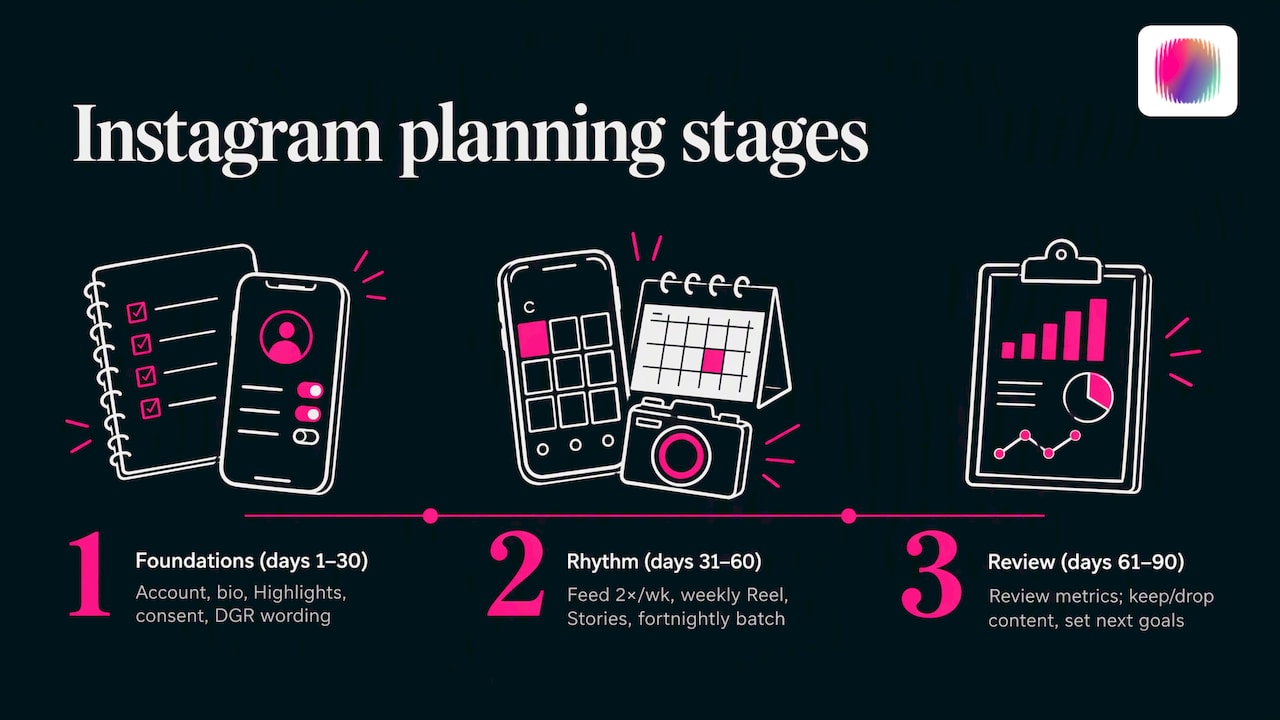
Days 1 to 30: foundations. Switch to a professional account, set the category, write the bio, create Highlights, agree your voice and pillars, and write a consent process. Add DGR wording to your donation page.
Days 31 to 60: rhythm. Post twice a week to the feed, add a Reel each week and use Stories for questions and behind-the-scenes. Batch-create content once a fortnight rather than daily.
Days 61 to 90: review and adjust. Look at saves, shares, profile visits and link clicks. Keep what people respond to, drop what they ignore and set the next quarter’s goals.
FAQ
How do I create an Instagram account for a nonprofit?
Sign up in the app with an email or phone number, then switch to a professional account in Settings. Choose the Nonprofit category, add your logo and write a short bio with a single link. Set up two-factor authentication and decide who has access.
Can I fundraise through Instagram in Australia?
Meta lists Australia among the countries where it offers fundraising tools for nonprofits, but you need to be approved, so check the current criteria. Whatever tool you use, state your DGR status clearly, because a platform does not make a donation tax-deductible. Check the fundraising rules for each state or territory you operate in.
What is the best social media platform for nonprofits?
It depends on your audience and your capacity. Instagram suits visual storytelling and reaching younger audiences, while other platforms may suit older donors or professional networks better. Choose one or two channels you can maintain well rather than spreading yourself across all of them.
What is the 3-2-1 rule on Instagram?
It is not a standard rule. Advice differs by source, and the research we reviewed recommends consistency and one clear call to action per post. Start with a rhythm you can sustain, such as two feed posts a week plus Stories, and refine it using your analytics.
Sources
- Instagram For Nonprofits: The Ultimate Guide (Wild Apricot)
- 10 Best Practices for Your Nonprofit’s Instagram Account (Anedot)
- Instagram and Nonprofits (GoHarness)
- How to Use Stories and Reels Strategically for Nonprofits
- Instagram Reels for Nonprofits and NGOs (ManyMotion)
- Alt Text and Captions on Instagram (Elgin Community College)
- Fundraising tools and solutions for nonprofits (Meta)
- Gifts and donations (ATO)
- This season notify donors of your DGR purpose and status (ATO)
- Donating to a natural disaster relief appeal or attending an event (ATO)
- ACNC welcomes the announcement of national fundraising red tape reform
- Posting photos and videos (OAIC)
- Privacy rights in Australia (OAIC)